
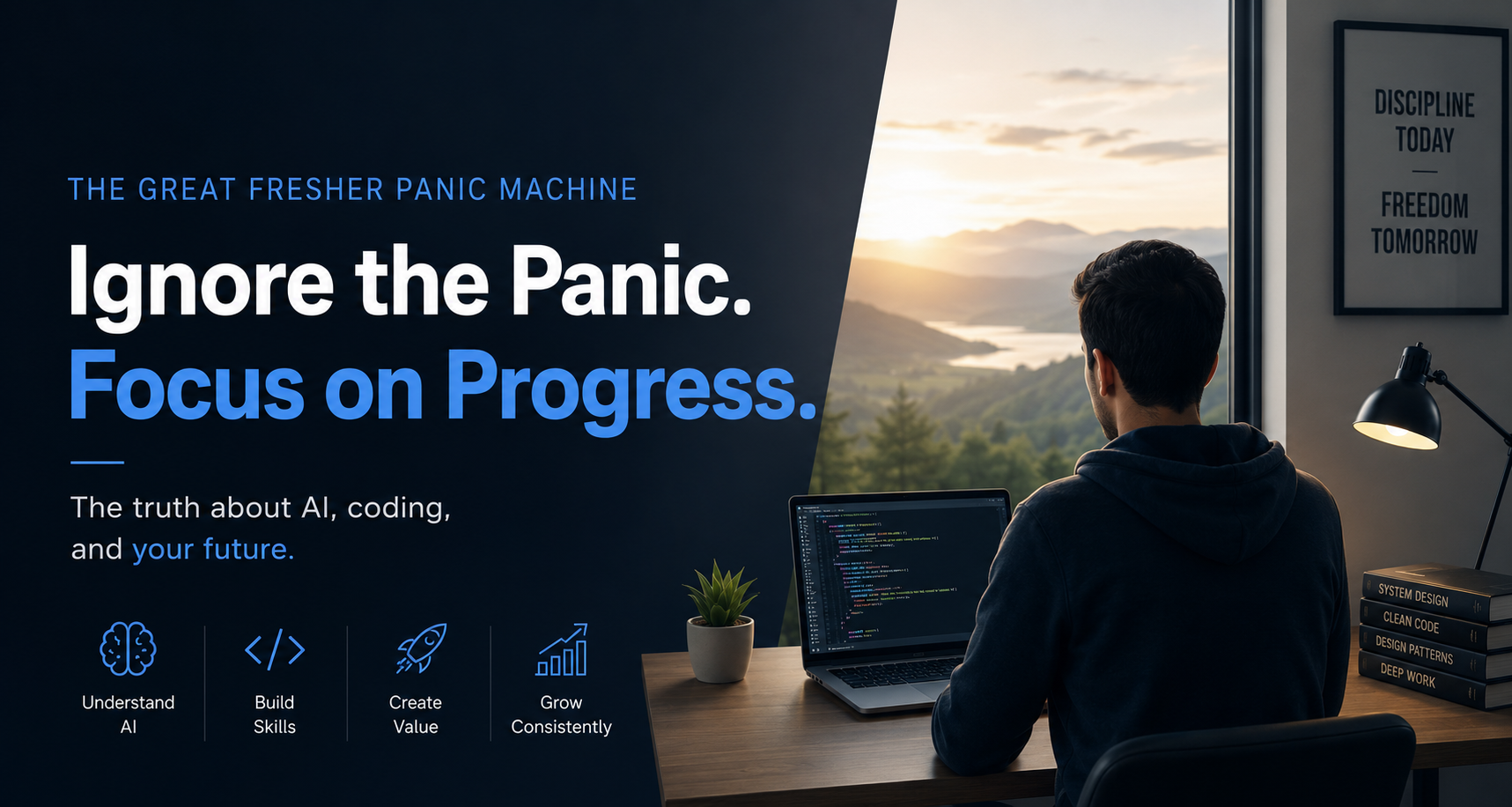
The Panic Machine Starts With a Scroll
Every few days, the same pattern unfolds across YouTube, Instagram, LinkedIn, Facebook, and X. A dramatic video appears with a bold caption claiming that software engineering is dying. Soon after, a clipped statement from a CEO or CTO circulates online, often paired with screenshots of AI-generated code and sweeping predictions about the future of work. Together, these posts fuel what has become a modern panic scam, where fear about AI, automation, and the future of software engineering is packaged into highly shareable content designed to capture attention rather than provide balanced analysis.
The message rarely changes.
“Developers are finished.”
“Freshers are doomed.”
“AI has replaced coding.”
“You’re already too late.”
Within hours, the content gathers thousands of likes, comments, and shares. Fear spreads rapidly because it attracts attention far more effectively than balanced discussion.
This phenomenon has become the panic scam of the modern technology industry.
The term does not suggest traditional fraud. Instead, it describes an attention-driven ecosystem where uncertainty is monetised. Anxiety generates engagement. Engagement increases reach. Reach creates influence and revenue. As a result, the most alarming claims often receive the greatest visibility.
For beginners, this panic scam can be especially damaging. Without real industry experience, separating legitimate technological change from exaggerated online narratives becomes difficult.
How Freshers Get Trapped in the Panic Scam
Imagine a student who has just spent several hours learning programming fundamentals. They finally understand loops, functions, and problem-solving concepts. Feeling encouraged, they open YouTube or Instagram during a short break.
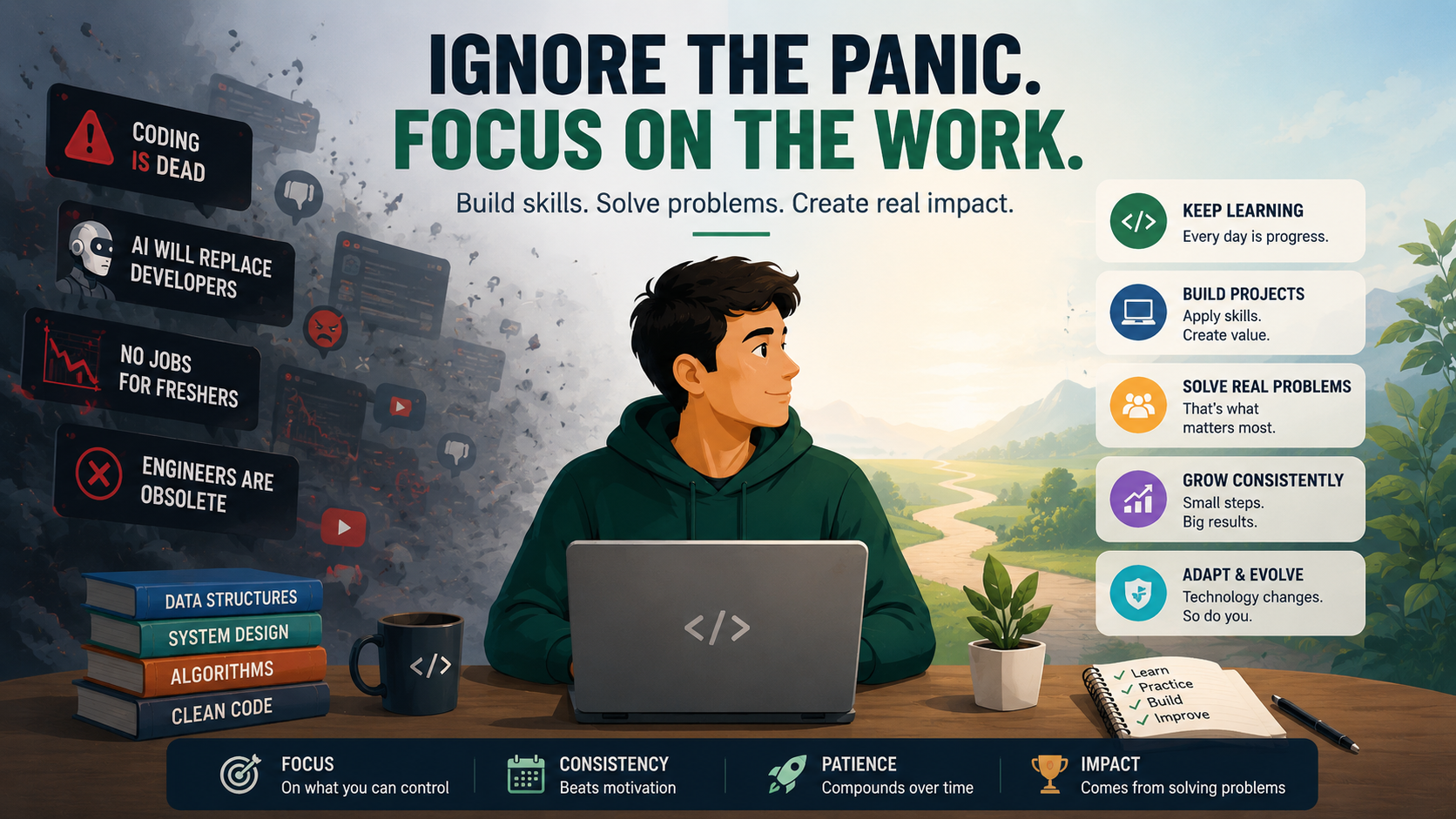
Almost immediately, they encounter a creator claiming AI can replace entire engineering teams.
Another video insists that companies no longer need developers.
A third confidently predicts that software engineering careers will disappear within a few years.
Repeated exposure to this content creates predictable questions.
Am I learning the wrong skill?
Should I abandon software engineering?
Have I already missed my chance?
Experienced professionals usually evaluate such claims through the lens of real-world work. Freshers lack that perspective, making them more vulnerable to panic-driven narratives.
The problem is not intelligence. Context is what most beginners are missing.
Without exposure to production systems, large-scale applications, long-term maintenance, or real engineering challenges, social media predictions can appear far more credible than they actually are.
That gap in experience is precisely what allows the panic scam to thrive.
Why Fear Generates More Attention Than Reality
The popularity of fear-based content is no accident. Modern platforms are designed to reward emotional reactions.
A post saying, “Keep learning and focus on fundamentals,” rarely sparks heated discussion.
By comparison, a headline announcing, “Stop Learning Coding Right Now,” immediately triggers curiosity, anxiety, disagreement, and debate.
Algorithms notice those reactions and amplify the content further.
Because of this dynamic, social media incentives often conflict with professional development. Viral posts reward urgency and emotion. Engineering careers reward patience and consistency.
The habits that build successful software engineers are rarely the same habits that generate millions of views.
Consequently, the panic scam often spreads faster than practical career advice.
Building Software and Talking About Software Are Different Things
Many beginners assume that visibility equals expertise.
That assumption creates another problem.
A creator may have hundreds of thousands of followers discussing technology every day. Such popularity does not automatically mean they have built large-scale systems, maintained critical infrastructure, or handled production incidents under pressure.
Discussing software and engineering software are separate activities.
Some individuals spend most of their time creating content rather than creating software. There is nothing wrong with content creation. Trouble begins when follower counts become a substitute for technical credibility.
Generating views is not the same as designing reliable systems.
Likewise, producing engaging short-form videos requires a completely different skill set from operating applications used by thousands or millions of people.
Recognising this distinction makes it easier to avoid the panic scam and evaluate information more critically.
The Difference Between a Demo and Real Engineering
Modern AI tools can produce impressive demonstrations within minutes.
A chatbot may generate a login page, create a CRUD application, or build a simple API almost instantly. Watching code appear on demand can create the illusion that software engineering has become effortless.
Reality is more complicated.
Building a login page is relatively simple. Creating an authentication system that remains secure, scalable, and resilient under heavy traffic is significantly harder.
Generating an API endpoint requires little effort. Maintaining an ecosystem of services around that endpoint demands expertise in reliability, monitoring, security, and performance.
As systems grow, databases become bottlenecks.
Unexpected traffic spikes introduce operational challenges.
Third-party failures force teams to design recovery mechanisms.
Security vulnerabilities require immediate responses without disrupting existing functionality.
Most of these responsibilities never appear in viral demonstrations because they cannot be condensed into a thirty-second clip.
Professional engineering begins where the demo ends.
What Panic Content Rarely Shows
Content built around fear focuses on possibilities rather than responsibilities.
Viewers see AI generating code.
They rarely see engineers troubleshooting outages at two in the morning.
Audiences watch applications being created.
Maintenance work that lasts for years is largely ignored.
Success stories receive enormous attention.
Security reviews, compliance requirements, incident response, technical debt, and operational complexity remain hidden behind the scenes.
A demo proves that software can be built.
Engineering proves that software can survive.
That distinction is often missing from panic-driven narratives.
The panic scam depends on simplifying complex realities into dramatic headlines.
AI Is Not the Enemy
Many viral posts present AI as an existential threat to developers.
The evidence tells a more nuanced story.
Recent AI tools have become incredibly valuable for learning, debugging, generating boilerplate code, and accelerating development workflows.
Those benefits are genuine.
Problems arise when every productivity improvement becomes a prediction about mass replacement.
This interpretation misunderstands how tools interact with expertise.
AI increases capability.
Responsibility still belongs to humans.
A junior developer can work more efficiently with AI assistance. An experienced engineer can leverage the same tools to achieve even greater productivity. Neither scenario removes the need for technical judgment, system design, or problem-solving ability.
Throughout history, tools have evolved continuously.
Demand for skilled people has remained.
The panic scam treats technological advancement as proof of extinction. Reality suggests adaptation is the more accurate conclusion.
Conclusion
Technology has always progressed through cycles of disruption, adjustment, and growth.
Every generation encounters predictions that a new language, framework, platform, or tool will eliminate existing careers.
History tells a different story.
The tools change.
The workflows evolve.
The headlines shift.
Meanwhile, organisations continue searching for people who can solve problems, build systems, and adapt to new challenges.
AI will undoubtedly transform software development further. Ignoring that reality would be unwise. At the same time, transformation should not be confused with extinction.
Freshers should avoid building career decisions around viral predictions designed to maximise engagement.
Instead, focus on fundamentals.
Build projects.
Learn how real systems behave.
Develop practical problem-solving skills.
Understand architecture, security, testing, debugging, and maintenance.
Algorithms are optimised to capture attention.
Engineers are trained to create value.
Those goals are fundamentally different.
The loudest voices online are not always the most accurate. In many cases, the people making the greatest progress are quietly improving their skills while the panic scam dominates the timeline.
Ignore the noise.
Question the fear.
Keep building.
The future belongs to those who continue learning while everyone else is distracted by panic.
Author’s Note: This article is an opinion and analysis piece based on observable industry trends, public reports, software engineering practices, and the evolving impact of AI on knowledge work. The term “panic scam” is used as a descriptive label for fear-driven engagement tactics commonly seen on social media and is not intended as an allegation against any specific individual or organisation.
References
- World Economic Forum – Future of Jobs Report 2025
https://www.weforum.org/reports/the-future-of-jobs-report-2025/ - Stanford University – AI Index Report 2025
https://aiindex.stanford.edu/report/ - GitHub – The State of AI in Software Development
https://github.com/resources/reports - Stack Overflow – Developer Survey 2024
https://survey.stackoverflow.co/2024/ - McKinsey & Company – The Economic Potential of Generative AI
https://www.mckinsey.com/capabilities/quantumblack/our-insights/the-economic-potential-of-generative-ai-the-next-productivity-frontier - Harvard Business Review – Human + Machine: Reimagining Work in the Age of AI
https://store.hbr.org/product/human-machine-reimagining-work-in-the-age-of-ai/10230 - MIT Press – Structure and Interpretation of Computer Programs
https://mitpress.mit.edu/9780262510875/structure-and-interpretation-of-computer-programs/ - Addison-Wesley – The Pragmatic Programmer
https://pragprog.com/titles/tpp20/the-pragmatic-programmer-20th-anniversary-edition/ - Addison-Wesley – The Mythical Man-Month
https://www.informit.com/store/mythical-man-month-essays-on-software-engineering-9780201835953 - Oxford University Press – Human-Centered AI
https://global.oup.com/academic/product/human-centered-ai-9780192845290/






Leave a Reply