
Introduction
The case of Junko Furuta is often described as one of the most horrifying crimes in modern history. Decades after her murder, people around the world continue to ask the same question:
What kind of person could commit such acts?
Many discussions focus on the brutality of the crime itself. Others focus on the failures of the justice system. Yet one aspect remains particularly disturbing: the psychology of the perpetrators.
Were the perpetrators psychopaths? Did they display traits associated with sadism? Or does this case challenge the assumption that only clinically abnormal individuals commit acts of extreme cruelty?
Or does this case reveal something far darker about human nature and the circumstances under which ordinary people can become capable of extraordinary cruelty?
This article examines the psychological profile of the offenders through the lens of modern forensic psychology, criminology, behavioural science, and peer-reviewed research. Rather than relying on emotion or sensationalism, the goal is to analyse documented behaviours and compare them with established scientific frameworks used to understand violent offenders.
Because no public psychiatric evaluation exists for the perpetrators, this article does not claim to diagnose them. Instead, it examines whether their actions displayed traits commonly associated with psychopathy, sadism, moral disengagement, and group-facilitated violence.
Understanding these mechanisms is important because crimes like this do not emerge from nowhere. They develop through patterns of behaviour, social influences, and psychological processes that researchers have studied for decades.
Recommended Reading
Before continuing, readers may find the following resources helpful:
Hidden Criminal Motive: The Mind We Don’t See — an exploration of the hidden motives, underlying drivers, and unanswered questions that.
The Junko Furuta Case Report — a comprehensive reconstruction of the crime, investigation, legal proceedings, and historical record.
Together, these resources provide important context for the psychological analysis presented in this article.
Understanding the Crime
In November 1988, seventeen-year-old Junko Furuta was abducted by a group of teenage offenders in Japan. What followed was not a spontaneous act of violence.
For approximately forty-four days, she was held captive and subjected to repeated physical, psychological, and sexual abuse. The cruelty escalated over time until her death in January 1989.
What makes this case particularly significant from a psychological perspective is that the abuse was prolonged. The perpetrators had countless opportunities to stop.
They did not.
Instead, the violence intensified.
For forensic psychologists, this distinction matters. Crimes committed in moments of rage are often driven by impulsive emotions. The Furuta case appears different. The prolonged nature of the abuse suggests a pattern of deliberate behaviour, sustained over weeks, despite repeated exposure to the victim’s suffering.
This is one of the reasons the case continues to attract attention from criminologists and behavioural researchers.
The First Question: Were the Offenders Psychopaths?
When people encounter this case, “psychopath” is often the first word that comes to mind.
The term itself is frequently misunderstood.
According to psychologist Robert D. Hare, one of the world’s leading experts on psychopathy, it is characterised by a combination of interpersonal, emotional, and behavioural traits.
These traits include:
- Lack of empathy
- Shallow emotional responses
- Manipulation
- Chronic antisocial behavior
- Callousness
- Lack of remorse
- Impulsivity
- Aggression
Importantly, psychopathy is not diagnosed based on a single act, no matter how horrific. It requires a comprehensive clinical assessment.
Since no publicly available psychiatric evaluations of the perpetrators exist, it would be inaccurate to definitively label them psychopaths.
However, what we can do is compare their documented behaviour against established psychopathy research.
The comparison is striking.
Psychopathy Trait #1: Extreme Lack of Empathy
Empathy is the ability to recognise and emotionally respond to another person’s suffering.
Most people experience psychological distress when witnessing pain.
Violent offenders often possess reduced empathy compared to the general population, but psychopathic offenders are particularly notable for their emotional detachment.
Research conducted by Hare and later neuroscientific studies suggest that psychopathic individuals frequently show diminished emotional responses to the suffering of others.
In the Furuta case, the abuse reportedly continued despite clear evidence of severe physical and emotional suffering.
The victim’s pain did not appear to discourage the offenders.
If anything, the violence escalated.
This behavioural pattern is consistent with what forensic researchers describe as extreme callousness.
While this alone cannot prove psychopathy, it represents one of the strongest behavioural indicators discussed in the scientific literature.
Psychopathy Trait #2: Absence of Remorse
One of the most frequently observed characteristics of psychopathic offenders is a lack of genuine guilt.
Most individuals experience remorse after causing serious harm.
Psychopathic personalities often display something different.
Instead of regret, they may justify their actions, minimise the damage, or shift responsibility elsewhere.
Psychologist Robert Hare describes this as a profound inability to emotionally connect with the consequences of one’s actions.
When examining the post-crime behaviour attributed to several perpetrators, researchers and commentators have frequently noted an apparent absence of meaningful remorse.
This does not prove psychopathy.
However, it aligns with one of the core traits commonly identified in psychopathic offenders.
Psychopathy Trait #3: Enjoyment of Dominance
One of the most disturbing aspects of the case is that much of the abuse appears to have served no practical purpose.
There was no financial gain.
There was no strategic objective.
Instead, the violence often appeared centred around humiliation, control, and domination.
This distinction is important.
Many violent crimes are instrumental. Violence becomes a means to achieve another goal.
In contrast, some offenders appear motivated by the power that violence provides.
Forensic psychologists have long recognised that domination itself can become rewarding.
The ability to completely control another human being can create a sense of superiority that some offenders actively seek.
This brings us to another important concept: sadism.
The Role of Sadism
Among all psychological frameworks relevant to this case, sadism may be the most unsettling.
Sadistic offenders derive psychological satisfaction from another person’s pain, humiliation, fear, or helplessness.
Researchers such as Jonathan Chopin and Eric Beauregard have identified several common characteristics of sadistic violence:
- Prolonged suffering
- Humiliation of victims
- Escalation of cruelty
- Enjoyment of power
- Desire for complete control
When comparing these characteristics with documented behaviours in the Furuta case, the overlap is difficult to ignore.
However, caution remains necessary.
Just as psychopathy requires clinical assessment, so does Sexual Sadism Disorder.
No publicly available diagnosis exists for the perpetrators.
Therefore, the responsible conclusion is not that they were diagnosed as sadists.
Rather, their actions displayed numerous behaviours that forensic researchers commonly associate with sadistic offending.
That distinction preserves both scientific accuracy and credibility.
The Psychology of Group Violence
One offender committing violence is disturbing.
Several offenders participating together is even more alarming.
Research consistently shows that group dynamics can dramatically increase cruelty.
Psychologist Philip Zimbardo argued that social environments can transform behaviour in ways individuals might never predict.
When people become part of a violent group, several psychological changes often occur:
- Personal responsibility decreases.
- Conformity increases.
- Moral boundaries weaken.
- Violence becomes normalised.
This phenomenon is known as diffusion of responsibility.
Individuals begin to think less as independent moral agents and more as members of a collective behaviour.
The result can be a dangerous escalation of behaviour.
One person commits an act.
Another imitates it.
A third tries to exceed it.
Over time, cruelty becomes normalised within the group.
This process helps explain how multiple offenders can collectively participate in acts that would seem unimaginable in isolation.
Childhood Environment and Family Influences
When discussing extreme offenders, attention often focuses on their actions as adults. However, criminologists and developmental psychologists have long argued that the roots of violent behaviour frequently begin much earlier.
A child’s understanding of empathy, accountability, respect, and conflict resolution is heavily influenced by the environment in which they are raised.
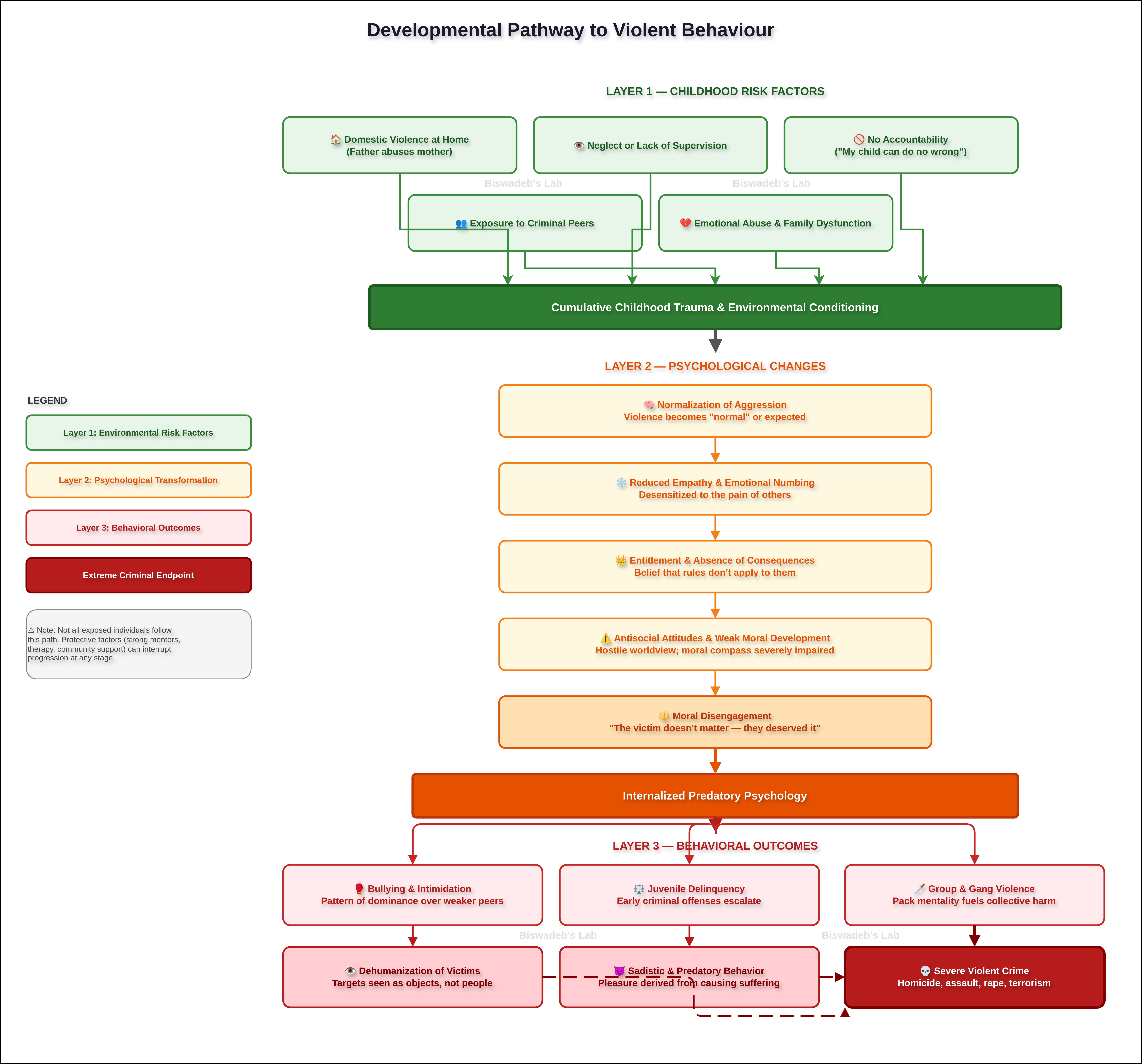
One significant risk factor is growing up in a home where violence is normalised. Children who regularly witness a father physically abusing their mother, or a mother abusing their father, or one parent intimidating the other through fear and aggression, may come to view violence as an acceptable way to exert power or resolve conflict. Over time, repeated exposure can desensitise them to the suffering of others and distort their understanding of healthy relationships.
Another concern is parental permissiveness and the absence of accountability. Some parents refuse to acknowledge wrongdoing by their children, consistently defending them regardless of their behaviour. When a child grows up believing they are never at fault and never faces meaningful consequences for harmful actions, they may develop an inflated sense of entitlement and a reduced sense of responsibility for the impact of their behaviour on others.
Researchers have also identified several other family-related risk factors associated with later antisocial behaviour, including:
- Chronic neglect
- Emotional abuse
- Physical abuse
- Inconsistent discipline
- Lack of parental supervision
- Exposure to criminal behaviour
- Absence of positive role models
- Family environments where aggression is rewarded or excused
Importantly, these factors do not automatically produce violent offenders. Millions of people experience difficult childhoods and never engage in serious criminal behaviour.
From Early Influences to Antisocial Behaviour
Human behaviour emerges from a complex interaction of personality, biology, social influences, peer groups, life experiences, and individual choices. Family environment is only one part of that equation.
Nevertheless, the family often serves as the first classroom in which children learn how to treat other people. When aggression is normalised, accountability is absent, and empathy is not reinforced, the risk of developing antisocial attitudes and behaviours can increase significantly.
These patterns do not always manifest as serious criminality. In many cases, they first appear as bullying, intimidation, ragging, delinquency, or a desire to dominate weaker individuals. Such behaviours can become reinforced when peer groups reward aggression, humiliation, or displays of power.
Over time, repeated exposure to these influences may contribute to reduced empathy, moral disengagement, and a growing willingness to disregard the suffering of others. While most individuals exposed to adverse childhood environments never become violent offenders, developmental psychologists have consistently found that early experiences can shape how people perceive authority, conflict, accountability, and human relationships.
Understanding these developmental influences does not excuse violent offenders. Rather, it helps identify warning signs that society, schools, communities, and families can address before harmful behaviours escalate into more serious forms of violence.
Moral Disengagement: How People Commit Evil Without Feeling Evil
One of the most influential theories in modern psychology is Albert Bandura’s.
Bandura proposed the concept of moral disengagement.
According to this theory, people often commit harmful acts by temporarily disconnecting their behaviour from their moral standards.
They do not necessarily stop seeing themselves as good people.
Instead, they create psychological justifications that allow harmful actions to continue.
Common mechanisms include:
- Dehumanising the victim
- Shifting responsibility
- Minimizing harm
- Rationalizing violence
- Following group norms
The Furuta case demonstrates several patterns that moral disengagement theory would predict.
Without these psychological mechanisms, sustaining such prolonged abuse would likely be far more difficult.
The offenders needed a way to suppress empathy.
Moral disengagement provides a powerful explanation for how that suppression occurs.
What This Case Teaches About Human Nature
Perhaps the most frightening lesson is that the case does not require supernatural evil to be understood.
The perpetrators were not fictional monsters.
They were human beings.
That reality is far more uncomfortable.
Research suggests that extreme cruelty can emerge when multiple risk factors converge:
- Criminal socialization
- Violence normalization
- Group reinforcement
- Lack of accountability
- Dehumanization
- Desire for dominance
- Moral disengagement
The case demonstrates how empathy can be systematically eroded when these factors operate together.
This understanding does not excuse the offenders.
If anything, it highlights how dangerous these psychological processes can become when left unchecked.
Conclusion
The murder of Junko Furuta remains one of the most disturbing criminal cases ever recorded.
While no responsible psychologist can diagnose the perpetrators without direct examination, their documented behaviour demonstrates remarkable overlap with traits associated with psychopathy, sadism, and extreme antisocial behaviour.
The evidence suggests individuals who displayed profound callousness, a willingness to inflict suffering, a desire for domination, and an apparent absence of empathy.
More importantly, the case reveals how group dynamics, moral disengagement, and dehumanisation can transform cruelty into routine behaviour.
Understanding these mechanisms is not about generating sympathy for offenders.
It is about recognising the warning signs that precede extreme violence.
The greatest tragedy of the Junko Furuta case is not merely what happened.
It is the realisation that the psychological forces behind it persist wherever empathy is replaced by power, accountability disappears, and human beings stop seeing other people as human.
Disclaimer
This article analyses the documented behaviours of the perpetrators using established research in forensic psychology, criminology, psychopathy, sadism, and moral disengagement. No formal psychiatric evaluation of the offenders has been publicly released; therefore, psychological concepts discussed herein are presented as analytical frameworks rather than clinical diagnoses.
References
- Hare, R. D. Without Conscience: The Disturbing World of the Psychopaths Among Us
https://www.goodreads.com/book/show/119730.Without_Conscience - Bandura, A. Moral Disengagement: How People Do Harm and Live With Themselves
https://www.cambridge.org/core/books/moral-disengagement - Zimbardo, P. The Lucifer Effect: Understanding How Good People Turn Evil
https://www.goodreads.com/book/show/359194.The_Lucifer_Effect - Blair, R. J. R. (2005). Applying a Cognitive Neuroscience Perspective to the Disorder of Psychopathy
https://www.ncbi.nlm.nih.gov/pmc/articles/PMC2242349/ - Glenn, A. L., & Raine, A. (2008). The Neurobiology of Psychopathy
https://pubmed.ncbi.nlm.nih.gov/18557282/ - Bandura, A., Barbaranelli, C., Caprara, G. V., & Pastorelli, C. (1996). Mechanisms of Moral Disengagement in the Exercise of Moral Agency
https://psycnet.apa.org/record/1996-01769-001 - Beauregard, E., & Chopin, J. (2022). Sexual Sadism and the Sexual Homicide Process
https://www.mdpi.com/1660-4601/19/14/8673 - Woodworth, M., & Porter, S. (2002). In Cold Blood: Characteristics of Criminal Homicides as a Function of Psychopathy
https://psycnet.apa.org/record/2002-15524-007 - Murder of Junko Furuta (Case Overview and Historical Documentation)
https://en.wikipedia.org/wiki/Murder_of_Junko_Furuta - National Diet Library of Japan (Historical Records & Archives)
https://www.ndl.go.jp




Leave a Reply