

Introduction
Cyber criminals have become one of the most influential hidden forces in the modern digital world. As businesses, governments, financial systems, and individuals increasingly depend on the internet, a parallel underground ecosystem has emerged beyond the visible web.
For years, people imagined cyber criminals as isolated hackers working alone. That image no longer reflects reality. In 2026, cyber criminals operate like organised enterprises with structures similar to technology companies. Many maintain leadership hierarchies, specialised technical teams, recruitment systems, customer support operations, and even internal performance metrics.
Cybercrime has evolved into one of the fastest-growing criminal industries worldwide. The underground economy surrounding cyber criminals generates billions through ransomware, phishing, financial fraud, identity theft, cryptocurrency crimes, and digital espionage.
Unlike traditional criminals, cyber criminals can operate across borders and target thousands of victims simultaneously. The rise of artificial intelligence, cryptocurrency, anonymous communication platforms, and dark web marketplaces has transformed how these groups function.
The hidden world of cyber criminals is not random chaos. It is a structured ecosystem built around profit, specialisation, and constant evolution.
Who Are Cyber Criminals?
Cybercriminals are individuals or groups that use digital technologies and computer systems to conduct illegal activities. Their goals vary depending on their motivations and operational structures.
Some cybercriminals focus purely on financial gain. Others conduct espionage operations, steal sensitive information, disrupt systems, or pursue ideological objectives.
Several categories of cybercriminals dominate today’s threat landscape.
Financial cybercriminals primarily seek money through fraud schemes, banking malware, ransomware attacks, and cryptocurrency theft.
Organised cyber crime groups operate much like traditional criminal syndicates. They maintain specialised divisions responsible for malware development, infrastructure management, social engineering, and money laundering.
Nation-state-affiliated actors sometimes blur the line between espionage and cybercrime. Certain operations involve intelligence gathering while simultaneously generating financial profits.
Hacktivists may conduct attacks for political or ideological purposes.
Insider threats involve employees or trusted individuals exploiting internal access for personal gain.
The boundaries between these categories often overlap. Modern cyber Criminals frequently cooperate, outsource services, and purchase specialised tools from underground markets.
Evolution of Cyber Crime: From Hobby Hackers to Digital Cartels
Cybercrime has undergone a dramatic transformation over the last several decades.
During the early years of computing, hacking was often driven by curiosity. Many early hackers explored systems for intellectual challenges rather than financial rewards.
As internet connectivity expanded during the 1990s and early 2000s, financially motivated attacks began increasing. Email scams, basic viruses, and credential theft became common.
The emergence of underground communities accelerated collaboration among cybercriminals. Forums allowed attackers to exchange knowledge, trade exploits, and sell stolen information.
Over time, operations became increasingly professional.
Today, cybercriminals function similarly to digital cartels. Large operations often employ specialists with dedicated roles:
- Malware developers create malicious software.
- Initial access brokers sell access to compromised systems.
- Phishing specialists manage credential harvesting campaigns.
- Infrastructure operators maintain servers and anonymous communication systems.
- Money laundering specialists move stolen funds through complex channels.
- Negotiators handle ransomware communications.
- These specialised roles transformed cybercrime from isolated attacks into scalable enterprises.
Business Model of Cyber Criminals
One of the most fascinating aspects of modern cyber Criminals is their business structure. Many underground organisations function similarly to legitimate businesses.
Traditional companies identify markets, create products, acquire customers, and generate revenue.
Cyber Criminals do exactly the same.
The primary difference is legality.
Most operations follow a business cycle:
- Target identification
- Infrastructure setup
- Attack deployment
- Monetization
- Revenue sharing
- Operational expansion
Many criminal groups now maintain affiliate programs where independent actors use existing infrastructure in exchange for profit sharing.
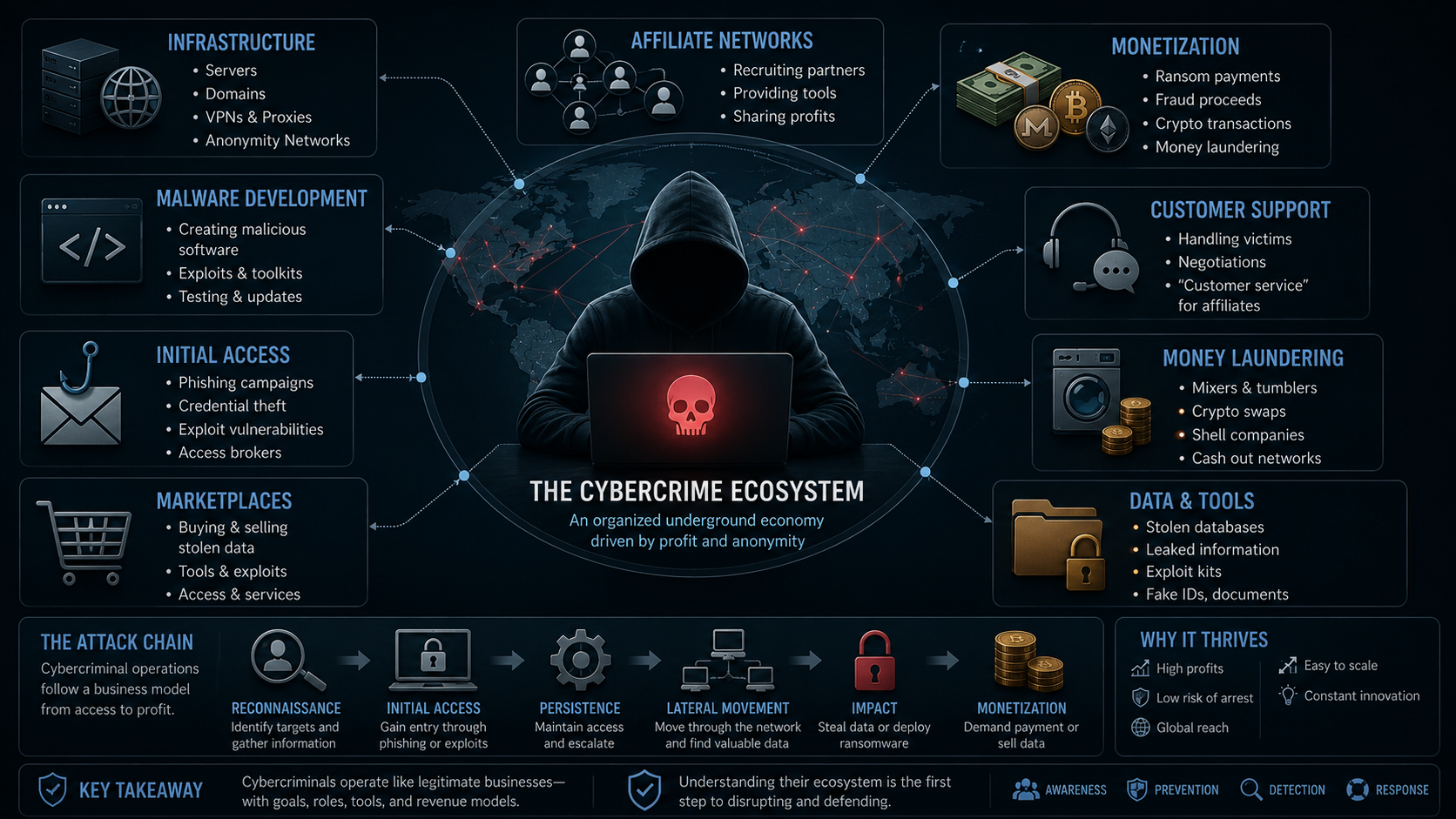
A ransomware organisation may provide encryption tools, negotiation portals, dashboards, payment systems, and technical support while affiliates conduct actual attacks.
Revenue models vary significantly.
Common sources include:
- Ransomware payments
- Credential theft
- Bank fraud
- Cryptocurrency scams
- Identity theft
- Stolen database sales
- Access brokering
- Corporate espionage
- Subscription-based malware services
- Underground software licensing
Some cyber Criminal groups even provide customer service. Victims paying ransomware demands occasionally receive technical assistance to restore encrypted files.
Ironically, certain cyber Criminal organizations provide better support than legitimate businesses.
Underground Economy and Dark Web Marketplaces
Cybercriminals rely heavily on underground marketplaces that operate beyond traditional internet visibility.
These marketplaces function as digital black markets where services, software, stolen data, and criminal tools are traded.
Products commonly sold include:
- Compromised credentials
- Credit card information
- Stolen databases
- Remote server access
- Malware kits
- Phishing templates
- Zero-day exploits
- Counterfeit documents
- Cryptocurrency laundering services
- Attack infrastructure
Dark web markets create an ecosystem where individuals with minimal technical knowledge can purchase tools previously available only to highly skilled attackers.
The result is democratized cyber crime.
A beginner with sufficient money can purchase complete attack packages and begin conducting operations almost immediately.
This accessibility significantly lowers the barrier to entry.
Tools and Techniques Used by Cyber Criminals
Cybercriminals continuously adapt to technological changes.
Their methods evolve rapidly because defensive systems improve every year.
Some of the most common techniques include phishing campaigns that trick users into revealing credentials.
Social engineering attacks manipulate human behaviour rather than exploiting technical vulnerabilities.
Ransomware remains one of the most profitable attack methods. Attackers encrypt data and demand payment for restoration.
Credential stuffing uses previously leaked passwords against multiple services.
Supply-chain attacks target trusted vendors to compromise downstream organisations.
Malware loaders establish persistence inside systems.
Fileless malware minimises detection by operating primarily in memory.
Artificial intelligence now plays an increasingly important role. AI-generated phishing messages, voice cloning, and automated reconnaissance have significantly improved attacker capabilities.
Deepfake technologies create additional challenges by enabling highly convincing impersonation attacks.
Cybercriminals continuously innovate because adaptation directly impacts profits.
Top Cybercriminals and Notorious Groups
Some cybercriminals and organised threat groups have become infamous because of their scale, sophistication, financial impact, and influence on global cybersecurity. Over time, cybercrime evolved from individual actors into highly structured criminal ecosystems.
Notorious Individuals
Kevin Mitnick was once considered one of the world’s most famous hackers. His activities belonged to an earlier era of hacking culture, and he later transitioned into becoming a security consultant. His story demonstrated how hacker culture evolved over time.
Albert Gonzalez orchestrated some of the largest credit card theft operations in history, compromising millions of payment card records through large-scale cybercrime networks.
Roman Seleznev became known for extensive financial cyber operations and large-scale carding activities that affected organisations worldwide.
Other well-known figures include Gary McKinnon, Max Butler (Iceman), and Jonathan James, whose cases became significant milestones in cybercrime history.
Notorious Cybercriminal Groups
Modern cybercrime increasingly revolves around organised groups rather than individuals. Many operate with clear hierarchies, affiliate programs, dedicated infrastructure teams, and financial divisions.
LockBit emerged as one of the most active ransomware operations globally and became known for its ransomware-as-a-service model.
Conti gained notoriety through large-scale attacks and extensive operational sophistication, functioning similarly to a structured business organisation.
DarkSide attracted worldwide attention after attacks impacting critical infrastructure, demonstrating the geopolitical impact of cybercrime.
Other highly notorious groups include:
- Black Basta – Known for targeting enterprises and high-value organisations using ransomware operations.
- Akira – A ransomware group responsible for attacks across multiple sectors and countries.
- Babuk – Recognised for data extortion tactics and attacks on major organisations.
- REvil (Sodinokibi) – One of the most prominent ransomware groups behind global extortion campaigns.
- Clop – Known for exploiting software vulnerabilities and conducting large-scale extortion operations.
- Maze – Popularised double-extortion tactics by encrypting and leaking stolen data.
- Ryuk – Associated with highly disruptive ransomware campaigns.
- FIN7 – A financially motivated cybercrime group linked to large-scale banking and retail compromises.
- Lazarus Group – Widely associated with financially motivated operations and international cyber activities.
- Anonymous Sudan and LAPSUS$ also gained significant attention through disruptive campaigns and social engineering tactics.
These organisations demonstrated that modern cybercriminals increasingly operate like structured businesses rather than isolated attackers, with affiliates, support systems, revenue-sharing models, and coordinated global operations.
The Rise of Ransomware-as-a-Service (RaaS)
One of the most significant developments in cybercrime has been the emergence of Ransomware-as-a-Service.
The concept mirrors legitimate Software-as-a-Service business models.
Instead of purchasing software outright, affiliates gain access to attack infrastructure and share profits.
Operators develop ransomware platforms while affiliates conduct attacks.
This structure allows rapid scaling.
Attackers no longer need advanced technical expertise because infrastructure, payment systems, encryption capabilities, and management portals already exist.
RaaS has dramatically increased the number of ransomware attacks globally.
Removing technical barriers, it created a cybercrime franchise system.
How Cyber Criminals Recruit and Operate
Cyber Criminal organizations require skilled personnel.
Recruitment often occurs through underground forums, encrypted messaging platforms, private communities, and invitation-only networks.
Candidates may undergo technical testing.
Some organisations recruit malware developers.
Others seek penetration testers, exploit researchers, translators, or infrastructure specialists.
Compensation models frequently include salaries, commissions, and profit-sharing arrangements.
Certain groups prohibit attacks against specific regions or countries.
Others enforce operational policies similar to employee handbooks.
The structure increasingly resembles remote technology companies.
The only difference is the legality of their operations.
Financial Impact on Businesses and Governments
The financial damage caused by cybercriminals continues to grow every year.
Direct losses include stolen funds, ransom payments, legal expenses, and incident response costs.
Indirect consequences can be even more severe.
Organisations frequently experience:
- Reputational damage
- Customer distrust
- Regulatory penalties
- Business interruptions
- Data recovery expenses
- Operational downtime
Governments face additional concerns involving national security and critical infrastructure protection.
Healthcare systems, transportation networks, and energy sectors increasingly represent attractive targets.
Cybercrime has evolved beyond isolated incidents into a major economic challenge.
How Law Enforcement Fights Cyber Crime
Law enforcement agencies worldwide continue adapting their strategies against cyber Criminals.
International cooperation has become essential because cyber attacks frequently cross national borders.
Investigators now combine digital forensics, cryptocurrency tracking, intelligence operations, and infrastructure takedowns.
Authorities increasingly target infrastructure rather than individual attackers alone.
Disrupting hosting systems, communication channels, and financial networks can significantly weaken criminal operations.
However, attribution remains difficult.
Cyber Criminals exploit anonymity technologies, false identities, proxy infrastructure, and jurisdictional limitations.
As technology evolves, the challenge becomes increasingly complex.
Future of Cyber Criminals in 2026 and Beyond
The future of cybercrime will likely involve greater automation, artificial intelligence integration, and increasingly sophisticated deception techniques.
AI-generated phishing campaigns may become highly personalised.
Voice cloning and deepfake technologies could create realistic impersonation attacks.
Autonomous malware systems may adapt dynamically based on victim environments.
Internet-connected devices continue expanding the attack surface.
Smart homes, industrial systems, healthcare devices, and connected infrastructure create additional opportunities for cybercriminals.
At the same time, defenders are adopting AI-driven detection systems, behavioural analytics, and automated response mechanisms.
The future may become an ongoing technological arms race between attackers and defenders.
Conclusion
The hidden world of cyber Criminals is far more sophisticated than many people realise. It is not simply a collection of isolated hackers launching random attacks. It is a global ecosystem driven by economics, organisation, specialisation, and innovation.
Cybercriminals have transformed underground operations into profitable enterprises with structures that mirror legitimate businesses. Their evolution reflects broader changes in technology itself. As digital systems become increasingly integrated into daily life, the opportunities for exploitation continue expanding.
Understanding cyber Criminals means understanding more than malicious software and security breaches. It requires recognising the economic systems, operational models, and underground markets that sustain these activities.
The digital battlefield of 2026 is no longer defined solely by technology. It is defined by the people and organisations operating in the shadows, constantly adapting, evolving, and reshaping the future of cyber conflict.
References
- FBI Cyber Division
https://www.fbi.gov/investigate/cyber - CISA (Cybersecurity and Infrastructure Security Agency)
https://www.cisa.gov - Europol European Cybercrime Centre (EC3)
https://www.europol.europa.eu/crime-areas-and-statistics/crime-areas/cybercrime - INTERPOL Cybercrime Directorate
https://www.interpol.int/Crimes/Cybercrime - IBM X-Force Threat Intelligence Index
https://www.ibm.com/reports/threat-intelligence - Verizon Data Breach Investigations Report (DBIR)
https://www.verizon.com/business/resources/reports/dbir/ - Kaspersky Securelist Research
https://securelist.com - Palo Alto Networks Unit 42
https://unit42.paloaltonetworks.com - CrowdStrike Global Threat Report
https://www.crowdstrike.com/global-threat-report/ - Mandiant Threat Intelligence Resources
https://www.mandiant.com/resources - MITRE ATT&CK Framework
https://attack.mitre.org - UNODC Cybercrime Resources
https://www.unodc.org/unodc/en/cybercrime/index.html - World Economic Forum Global Cybersecurity Outlook
https://www.weforum.org/reports/global-cybersecurity-outlook/ - Chainalysis Crypto Crime Reports
https://www.chainalysis.com/crypto-crime/







Leave a Reply