
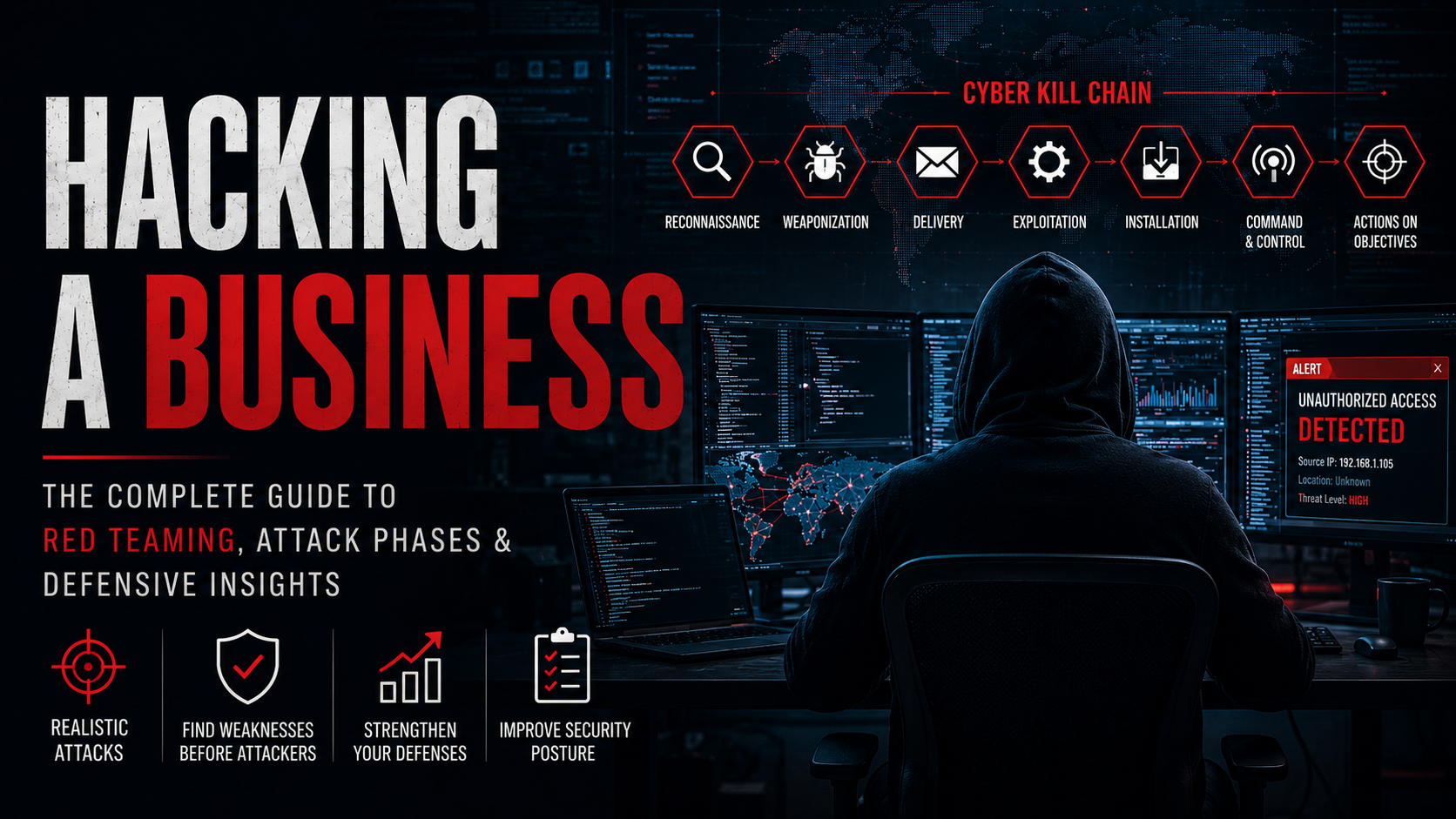
Most people hear the word hack and immediately think about cybercriminals, ransomware groups, or malicious actors breaking into systems. In reality, companies around the world legally hire cybersecurity professionals to hack their own infrastructure every day.
Banks, healthcare organisations, government agencies, technology companies, and Fortune 500 enterprises regularly authorise security teams to simulate real-world attacks against their systems. The goal is simple: discover weaknesses before real attackers do.
This process is known as Red Teaming.
A legal hack is not about causing damage, stealing data, or disrupting business operations. It is a controlled security assessment designed to answer one important question:
If a real attacker tried to hack this company tomorrow, how far could they get?
Understanding the answer helps organisations improve security, strengthen defences, and reduce the risk of future breaches.
What Does It Mean to Hack a Company Legally?
To hack a company legally, security professionals must have explicit written authorisation from the organisation. The company defines the scope, objectives, timelines, and rules of engagement before testing begins.
The purpose of a legal hack is to evaluate:
- Security controls
- Detection capabilities
- Incident response readiness
- Identity security
- Employee awareness
- Network segmentation
- Cloud security posture
- Data protection mechanisms
Without authorisation, attempting to hack a company is illegal in most jurisdictions. With authorisation, the same techniques become a valuable part of professional cybersecurity testing.
That distinction is what separates a red team operator from a criminal attacker.
Red Teaming vs Penetration Testing
Many people assume penetration testing and red teaming are the same thing. They are not.
A penetration test is typically focused on finding vulnerabilities within a specific target.
For example:
“Test this web application for security weaknesses.”
A red team engagement takes a broader approach.
For example:
“Hack our organisation the way a real threat actor would and show us how far you can get.“
Penetration testing focuses on vulnerabilities.
Red teaming focuses on attack paths.
A pentester might identify a SQL injection vulnerability.
A red team operator asks:
“Can this vulnerability help me gain access, escalate privileges, move laterally, reach sensitive systems, and simulate data theft without being detected?“
That difference makes red teaming one of the most realistic ways to assess organisational security.
Why Companies Pay People to Hack Them
Most organisations already invest heavily in security.
They deploy:
- Firewalls
- Endpoint protection
- SIEM platforms
- EDR and XDR solutions
- Security awareness training
- Vulnerability scanners
- Compliance frameworks
Yet major breaches still occur.
Why?
Because attackers rarely rely on a single weakness.
Instead, they combine multiple small weaknesses into a successful attack path.
One exposed credential.
One forgotten server.
One phishing email.
One misconfigured cloud service.
One weak password.
A legal hack helps organisations understand how these seemingly minor issues can be chained together to create a serious security incident.
The MITRE ATT&CK Framework
Modern red teams often map their activities to the MITRE ATT&CK Framework.
MITRE ATT&CK is a knowledge base of real-world attacker behaviour. Instead of focusing on malware families, it focuses on techniques used by adversaries.
Examples include:
- Phishing
- Credential dumping
- PowerShell abuse
- Pass-the-Hash
- Kerberoasting
- DLL hijacking
- Lateral movement
- Data exfiltration
Using a common framework allows organisations to measure security coverage and understand exactly how attackers may attempt to hack their environment.
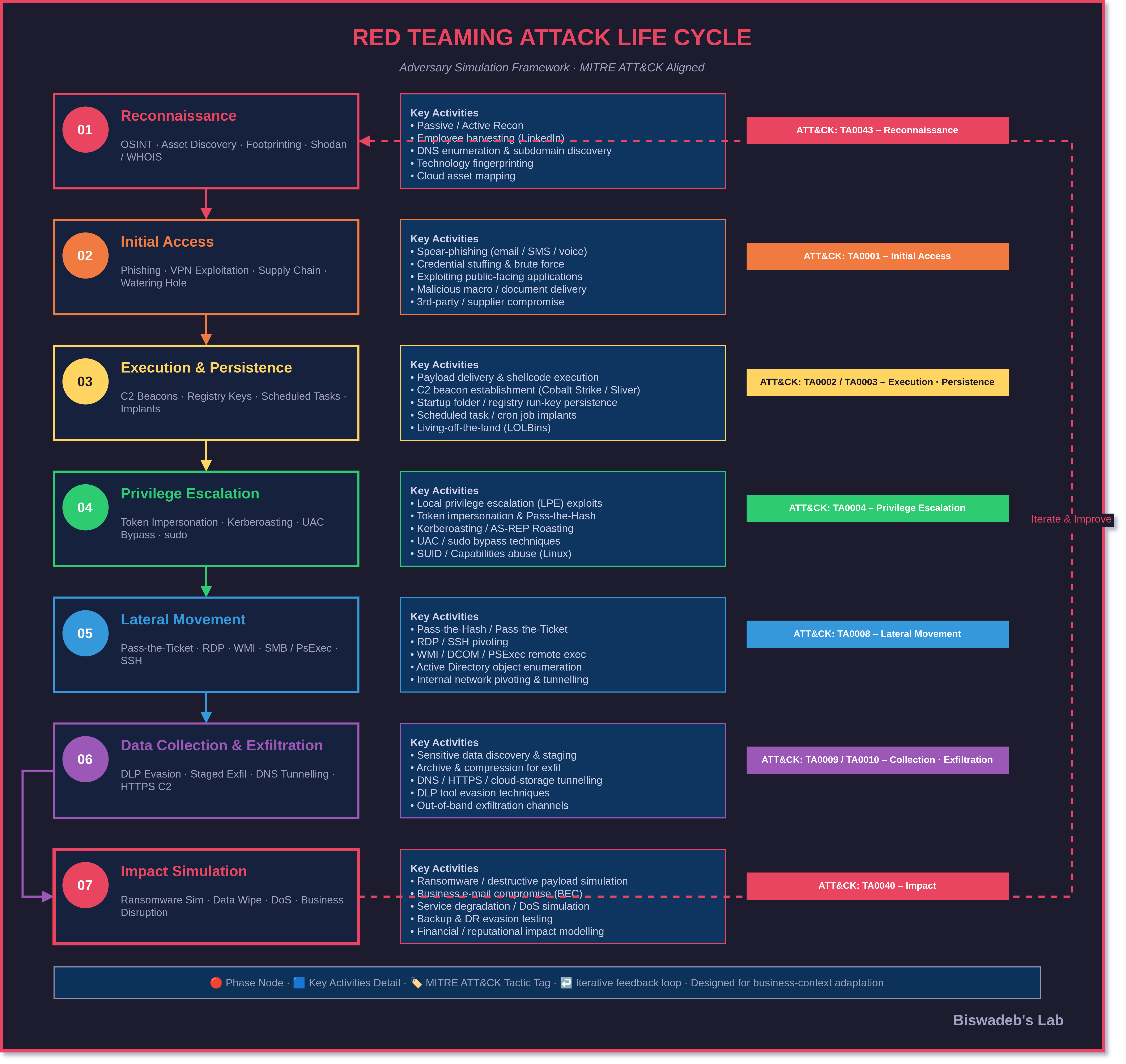
The Cyber Kill Chain
Before examining the individual phases of a red team engagement, it is helpful to understand how attackers typically progress through a successful intrusion.
One of the most influential models in cybersecurity is the Cyber Kill Chain, a framework originally developed by Lockheed Martin to describe the stages of a cyber attack from initial targeting to achieving operational objectives.
The framework provides a high-level view of how adversaries conduct attacks and helps organisations identify opportunities to detect, disrupt, and stop malicious activity before significant damage occurs.
The traditional Cyber Kill Chain consists of seven stages:
- Reconnaissance: The attacker gathers information about the target, including infrastructure, technologies, employees, exposed services, and potential entry points.
- Weaponisation: The attacker prepares tools, payloads, phishing documents, malware, or exploit chains that will be used during the operation.
- Delivery: The payload is delivered to the target through methods such as phishing emails, malicious websites, compromised software, removable media, or exposed services.
- Exploitation: A vulnerability is exploited, or a user action is triggered, allowing the attacker to gain access to the target environment.
- Installation: The attacker establishes a foothold by deploying malware, creating persistence mechanisms, or obtaining long-term access to compromised systems.
- Command and Control (C2): The compromised system communicates with attacker-controlled infrastructure, enabling remote control, tasking, and data exchange.
- Actions on Objectives: The attacker pursues their ultimate goals, which may include privilege escalation, lateral movement, credential theft, data exfiltration, ransomware deployment, espionage, or operational disruption.
While modern attacks do not always follow these stages in a perfectly linear manner, the Cyber Kill Chain remains a valuable model for understanding adversary behaviour and improving defensive strategies.
Many organisations use the Cyber Kill Chain alongside the MITRE ATT&CK Framework. The Cyber Kill Chain explains the overall progression of an attack, while ATT&CK provides detailed insight into the specific tactics and techniques adversaries use at each stage.
From a red team perspective, the Cyber Kill Chain serves as a useful blueprint for emulating realistic attacker behaviour and evaluating whether an organisation can detect and respond to threats throughout the entire attack lifecycle.
Phase 1: Reconnaissance
Every successful attempt to hack a company starts with information gathering.
Before touching a target system, operators try to understand the environment.
Reconnaissance may include:
- DNS enumeration
- Infrastructure mapping
- Employee profiling
- Cloud asset discovery
- Credential leak analysis
- Technology stack identification
- Open-source intelligence collection
A surprising amount of information is publicly available.
Employees often reveal internal technologies on LinkedIn.
Developers accidentally expose secrets in public repositories.
Misconfigured cloud assets become searchable.
Forgotten systems remain exposed to the internet.
Good reconnaissance creates realistic attack paths and improves the overall effectiveness of a red team engagement.
Phase 2: Initial Access
Initial access is the stage where operators gain their first foothold inside an environment.
Modern organisations are increasingly targeted through identity-based attacks rather than software vulnerabilities.
Common areas tested during a legal hack include:
- Phishing resistance
- VPN exposure
- Weak authentication controls
- Credential reuse
- Password spraying risks
- Web application vulnerabilities
- Third-party access paths
In many cases, a compromised account is more valuable than an expensive exploit because it provides legitimate-looking access to company resources.
Social Engineering: Hacking the Human Layer
Technology is not always the weakest link.
People often are.
Social engineering focuses on manipulating trust rather than exploiting software vulnerabilities.
Authorised assessments may simulate:
- Phishing campaigns
- Fake login portals
- Phone-based impersonation
- Malicious document delivery
- USB drop exercises
- Physical security testing
The purpose is not to embarrass employees.
The objective is to evaluate whether staff can recognise suspicious activity and whether security teams can detect abuse after compromise.
Phase 3: Execution and Persistence
After gaining access, attackers typically attempt to maintain their foothold.
Red teams simulate this behaviour in a controlled manner.
This stage may involve:
- Scheduled task abuse
- Service modification
- Registry persistence
- WMI subscriptions
- Startup execution paths
- Token manipulation
The objective is to determine whether security controls can identify persistence mechanisms before they become a long-term threat.
Privilege Escalation
A compromised user account is rarely the final objective.
Attackers usually seek elevated privileges to gain deeper access into an environment.
Privilege escalation often targets:
- Active Directory
- Domain controllers
- Service accounts
- Cloud identities
- Federation services
Common escalation opportunities include:
- Misconfigured permissions
- Credential reuse
- Weak delegation settings
- Insecure service configurations
- Unpatched vulnerabilities
Identity security has become one of the most important battlegrounds in modern cybersecurity.
Living Off the Land
Modern attackers increasingly avoid deploying custom malware.
Instead, they abuse legitimate tools already present on systems.
This approach is known as Living Off the Land.
Examples include:
- PowerShell
- WMI
- Scheduled Tasks
- Remote Desktop Protocol
- Windows administrative tools
Because these tools are used by administrators every day, they can be difficult to distinguish from malicious activity.
This creates a significant challenge for defenders.
Lateral Movement
Compromising one machine rarely achieves an attacker’s objectives.
To reach valuable assets, attackers move throughout the environment.
This process is known as lateral movement.
Red teams evaluate whether an attacker could pivot from:
- A workstation to a server
- One department to another
- On-premises infrastructure to cloud services
- Development environments to production systems
This phase tests:
- Network segmentation
- Administrative boundaries
- Identity trust relationships
- Internal monitoring capabilities
Organisations often discover that internal defences are far weaker than their perimeter protections.
Data Collection and Exfiltration
At some point, every attack becomes a data problem.
Attackers are usually interested in:
- Intellectual property
- Customer records
- Authentication data
- Financial information
- Internal documentation
- Source code
- Cloud credentials
A legal hack may simulate controlled data collection and exfiltration to determine whether the organisation can detect suspicious activity before sensitive information leaves the environment.
The goal is validation, not theft.
Impact Simulation
Professional red teams rarely perform destructive actions.
Instead, they simulate impact safely.
Examples include:
- Demonstrating domain administrator access
- Simulating ransomware deployment
- Proving access to sensitive databases
- Demonstrating cloud account takeover
- Showing the ability to disable security controls
Organisations receive evidence of risk without suffering operational disruption.
Rules of Engagement
Every legal hack operates within clearly defined boundaries.
Before testing begins, both parties establish:
- Scope
- Authorized targets
- Testing windows
- Communication procedures
- Safety restrictions
- Escalation contacts
- Data handling requirements
- Reporting expectations
These rules protect both the organisation and the red team while ensuring the exercise remains safe and effective.
The Future of Legal Hacking
Cybersecurity continues to evolve rapidly.
Modern organisations rely on:
- Cloud infrastructure
- Identity providers
- SaaS applications
- APIs
- CI/CD pipelines
- Remote work environments
- Artificial intelligence
As attack surfaces grow, organisations need realistic ways to validate their defences.
That is why legal hacking, red teaming, and adversarial simulations continue to become more important every year.
Final Thoughts
The phrase “How to Hack a Company Legally” may sound controversial, but it represents one of the most valuable security practices available today.
Organisations cannot effectively defend against attackers without understanding how real attacks unfold.
A legal hack provides that perspective.
It reveals weaknesses before criminals discover them.
It tests people, processes, and technology under realistic conditions.
Most importantly, it helps organisations move beyond assumptions and understand their true security posture.
The companies that withstand modern cyber threats are not the ones that assume they are secure.
They are the ones willing to test that assumption before a real attacker does.
References
- MITRE ATT&CK Framework
https://attack.mitre.org/ - MITRE ATT&CK Enterprise Matrix
https://attack.mitre.org/matrices/enterprise/ - Lockheed Martin Cyber Kill Chain
https://www.lockheedmartin.com/en-us/capabilities/cyber/cyber-kill-chain.html - National Institute of Standards and Technology (NIST) Cybersecurity Framework
https://www.nist.gov/cyberframework - NIST Special Publication 800-61: Computer Security Incident Handling Guide
https://csrc.nist.gov/publications/detail/sp/800-61/rev-2/final - NIST Special Publication 800-115: Technical Guide to Information Security Testing and Assessment
https://csrc.nist.gov/publications/detail/sp/800-115/final - OWASP Web Security Testing Guide (WSTG)
https://owasp.org/www-project-web-security-testing-guide/ - OWASP Top 10 Web Application Security Risks
https://owasp.org/www-project-top-ten/ - Centre for Internet Security (CIS) Controls
https://www.cisecurity.org/controls - CISA Cybersecurity Resources and Guidance
https://www.cisa.gov/ - Microsoft Security Documentation
https://learn.microsoft.com/security/ - Red Teaming Guidance from MITRE Engenuity’s ATT&CK Evaluations
https://attackevals.mitre-engenuity.org/ - Google Cloud Security Best Practices
https://cloud.google.com/security - AWS Security Documentation
https://docs.aws.amazon.com/security/ - Microsoft Azure Security Documentation
https://learn.microsoft.com/azure/security/






Leave a Reply