
For more than two decades, the Indian middle class followed a simple formula for success. Study hard, secure admission to an engineering college, earn an Engineering Degree, and step directly into a stable, well-paying job.
Parents invested lakhs of rupees in tuition fees. Students spent four years attending lectures, writing examinations, and completing assignments. In return, they expected that coveted Engineering Degree to unlock a secure future.
For many years, the formula worked.
Large IT service companies such as TCS, Infosys, Wipro, Cognizant, and HCL hired thousands of graduates every year through campus placements. Freshers were not expected to be experts. Companies trained them after recruitment and, over time, transformed them into productive employees.
That era is ending.
Today, an Engineering Degree alone is no longer enough. The technology industry has evolved faster than India’s education system, creating a dangerous gap between what colleges teach and what employers actually need.
The result is a growing crisis where students graduate with degrees but struggle to build careers.
The Engineering Degree Bubble
India produces nearly one million engineering graduates every year through thousands of engineering institutions. Yet employers continue to complain about skill shortages.
At first glance, this seems impossible.
How can a country produce so many engineers while companies still struggle to hire qualified talent?
The answer lies in a simple reality: quantity does not equal quality.
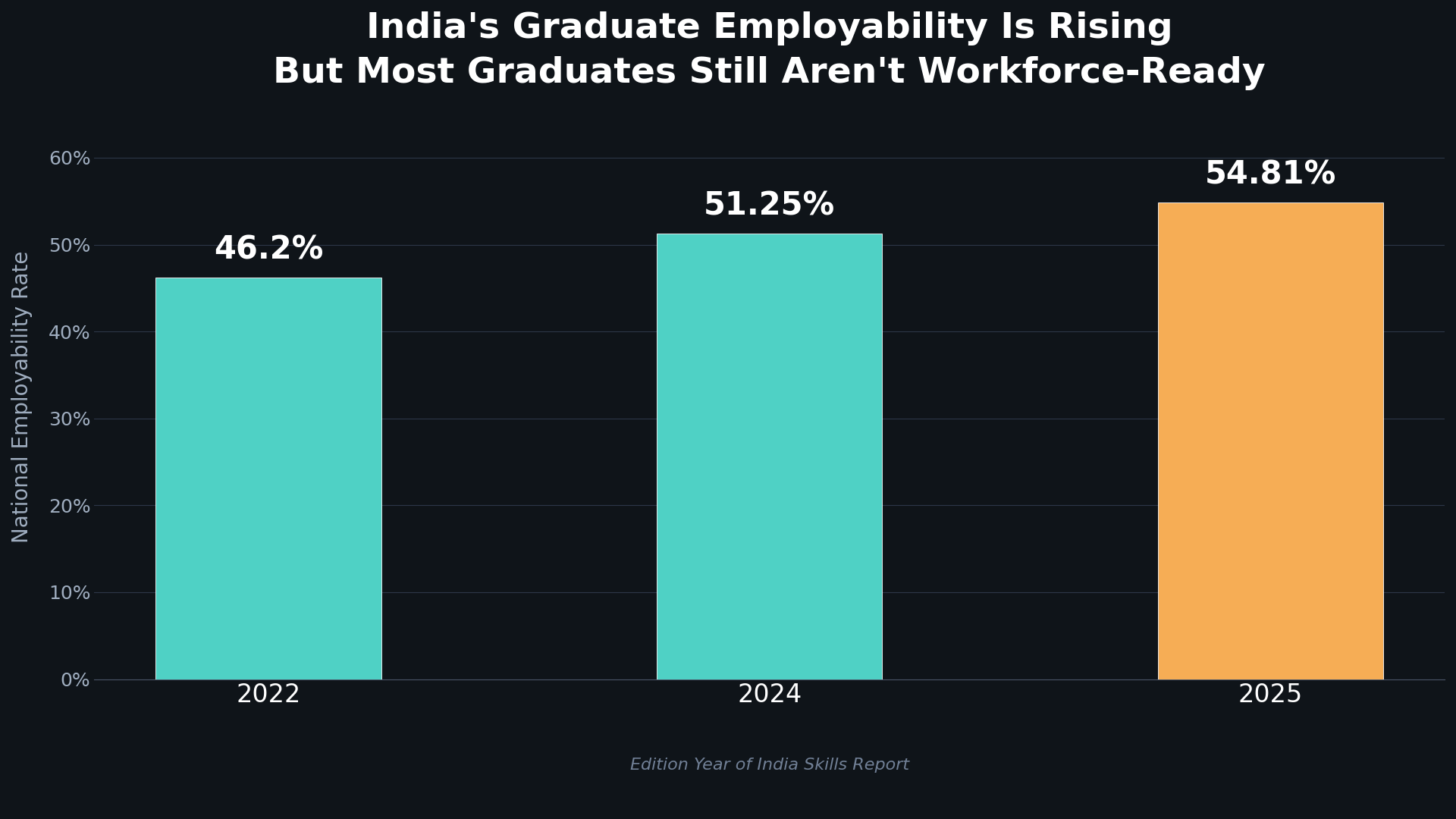
Recent employability studies reveal a troubling picture. According to the India Skills Report 2025, overall graduate employability stands at approximately 55%, while engineering graduates show employability levels around 71.5%. However, employability does not automatically translate into employment. Many graduates still fail to secure jobs that match their qualifications or career expectations.
Even more concerning, reports from industry hiring platforms indicate that a large percentage of engineering graduates remain unplaced despite active recruitment in the market. The issue is not a lack of jobs. The issue is a mismatch between skills and demand.
An Engineering Degree has become abundant.
Practical engineering skills have not.
The Death of Mass Hiring
For years, India’s IT industry operated on a bulk hiring model.
Companies recruited thousands of graduates because software development involved repetitive and labour-intensive tasks. Businesses needed large teams to maintain applications, test software, and support enterprise systems.
Today’s technology landscape is completely different.
Cloud infrastructure, automation platforms, DevOps pipelines, artificial intelligence, cybersecurity frameworks, and low-code development tools have dramatically reduced the need for large entry-level workforces.
Companies are now searching for specialists rather than trainees.
Instead of hiring 10 fresh graduates to perform routine tasks, a company may hire one engineer who understands cloud architecture, automation, containerization, and AI-assisted development.
The modern workforce rewards capability over credentials.
This is where the traditional Engineering Degree begins to lose its value.
A degree proves that you completed a curriculum.
It does not prove that you can solve real-world problems.
The Blackboard Engineering Crisis
One of the biggest failures in technical education is not the syllabus itself.
Many modern curricula already include concepts such as:
- Cloud Computing
- Docker
- Kubernetes
- DevOps
- Cybersecurity
- Artificial Intelligence
- Machine Learning
- Data Engineering
On paper, these subjects appear highly relevant.
The problem is implementation.
Many colleges teach advanced technologies as theoretical subjects rather than practical skills.
Students often memorise Docker commands without ever deploying a container.
They write DevOps definitions in answer sheets without configuring a CI/CD pipeline.
They learn cybersecurity concepts without performing a real vulnerability assessment.
This creates a generation of graduates who understand terminology but lack experience.
The result is “Blackboard Engineering” — an educational system where students learn to describe technology without learning how to use it.
Employers quickly identify this gap during technical interviews.
The Faculty Problem Nobody Wants to Discuss
A deeper issue lies within the academic workforce itself.
The technology industry evolves at an extraordinary pace.
A cloud architect or cybersecurity engineer with current industry expertise can easily earn between ₹15 lakh and ₹40 lakh annually, often much more. Meanwhile, many colleges struggle to attract such professionals because academic salaries are significantly lower.
As a result, institutions frequently rely on faculty members who have spent most of their careers inside academia rather than industry.
This creates an unfortunate cycle.
Faculty teach outdated methods.
Students graduate with outdated skills.
Employers reject graduates.
Colleges blame the market.
The market blames colleges.
Nothing changes.
Until educational institutions reward practical expertise, the value of the Engineering Degree will continue to decline.
Artificial Intelligence Has Changed the Rules
The arrival of AI has accelerated the crisis.
Tools such as AI coding assistants can now generate boilerplate code, create documentation, write test cases, and automate repetitive development tasks.
Many of the entry-level activities traditionally assigned to fresh graduates are being partially automated.
This changes what companies are willing to pay for.
Businesses no longer need people who simply write code.
They need people who can:
- Design systems
- Understand architecture
- Secure infrastructure
- Solve complex problems
- Integrate AI tools effectively
- Build scalable products
In other words, companies increasingly hire thinkers and builders rather than coders alone.
An Engineering Degree that focuses solely on textbook programming is becoming less relevant every year.
The Skill Gap Behind the Numbers
The latest labour market data reveals a mixed reality.
India’s overall employability has improved from 46.2% in 2022 to over 56% in 2026. Engineering graduates remain among the most employable categories, particularly those from Computer Science and IT backgrounds.

However, another major study assessing over one million learners across 2,700 campuses found overall graduate employability at only 42.6%.
These numbers reveal an important truth.
The market is not rejecting degrees.
The market is rewarding skills.
Students with strong portfolios, internships, open-source contributions, cloud certifications, cybersecurity projects, and practical experience continue to find opportunities.
Students who rely solely on their Engineering Degree increasingly struggle.
Why India Starts Engineering Education Too Late
The problem begins long before college.
Most Indian students encounter serious computer science concepts only after entering higher education.
Before that, technology education is often limited to:
- MS Word
- PowerPoint
- Basic computer operation
- Internet browsing
This approach treats technology as a tool for consumption rather than creation.
By the time students enter engineering programs at age eighteen, they are expected to absorb years of technical knowledge within a few semesters.
The result is predictable.
Memorisation replaces understanding.
Exams replace experimentation.
Certificates replace competence.
A stronger solution would involve introducing engineering fundamentals during middle school.
Engineering Should Begin in Class 8
Imagine a system where students learn:
Version Control
Students use Git and GitHub from an early age to track projects and collaborate effectively.
Programming Logic
Instead of memorising syntax, students learn problem-solving through practical software projects.
APIs and Systems Thinking
Students understand how applications communicate and how digital services function.
Containerization
Concepts such as Docker become normal development practices rather than advanced topics.
Cybersecurity Awareness
Students learn how systems fail, how attacks occur, and how secure software is built.
By the time these students reach college, they would already possess a strong technical foundation.
Universities could then focus on advanced engineering, research, innovation, and entrepreneurship rather than basic technical literacy.
The Hard Truth About an Engineering Degree
None of this means an Engineering Degree is useless.
A degree still matters.
Many employers require one.
Government jobs often require one.
Graduate programs and higher education pathways depend on one.
The mistake is believing that the Engineering Degree itself creates value.
It doesn’t.
The project that you will do will add value.
The ability to solve problems creates value
Your skills create value.
And in front of a recruiter, you can show these values, which will make you stand out.
The degree merely verifies that you completed a formal educational process.
In today’s economy, that verification alone is rarely enough.
What Students Should Do Right Now
If you are currently pursuing an Engineering Degree, focus on building assets that employers can actually evaluate.
These include:
- GitHub repositories
- Open-source contributions
- Cloud projects
- Security labs
- Freelance work
- Technical blogs
- Personal websites
- Certifications
- Real-world applications
Treat college as a compliance requirement.
Treat skill development as your real education.
The students who thrive over the next decade will not necessarily come from the most expensive colleges.
They will be the ones who consistently build, learn, experiment, and adapt.
Conclusion
The promise that an Engineering Degree guarantees a successful career is one of the biggest myths in modern India.
If anyone says that to you, don’t believe it. It’s a scam!!
The technology market has changed.
Artificial intelligence has changed.
Hiring practices have changed.
Employer expectations have changed.
Unfortunately, much of higher education has not.
The future belongs to engineers who can demonstrate capability, not merely credentials.
The era of collecting degrees is fading.
The era of building skills has arrived.
An Engineering Degree may open a door, but only real expertise will allow you to walk through it.
Disclaimer: This article is an independent market analysis and opinion piece based on publicly available data, industry hiring trends, employability reports, and technology workforce research. Employment outcomes may vary depending on an individual’s skills, experience, specialisation, and market conditions.
References
The analysis and observations presented in this article are supported by publicly available industry reports, employability studies, education surveys, and labour market research.
- India Skills Report 2025, Wheebox, Confederation of Indian Industry (CII), AICTE, and AIU
https://wheebox.com/india-skills-report - India Graduate Skill Index 2025, Mercer | Mettl Research Report
https://resources.mettl.com/research/india-graduate-skill-index-2025 - Future of Jobs Report 2025, World Economic Forum
https://www.weforum.org/reports/the-future-of-jobs-report-2025 - All India Survey on Higher Education (AISHE), Ministry of Education, Government of India
https://aishe.gov.in - All India Council for Technical Education (AICTE)
https://www.aicte-india.org - University Grants Commission (UGC)
https://www.ugc.gov.in - NASSCOM Strategic Review and Technology Industry Reports
https://nasscom.in - “India’s Engineering Education: Bridging the Skills Gap for Tomorrow’s Workforce”, Economic Times Education
https://education.economictimes.indiatimes.com/news/higher-education/indias-engineering-education-bridging-the-skills-gap-for-tomorrows-workforce/129918437 - “85% of Engineering Graduates and 74% of B-School Students Unplaced Despite Hiring Demand”, Times of India Education
https://timesofindia.indiatimes.com/education/careers/news/85-of-engineering-graduates-and-74-of-b-school-students-unplaced-despite-88-employers-hiring-where-is-the-loophole/articleshow/129673546.cms - India Brand Equity Foundation (IBEF), Employability and Workforce Development Analysis
https://www.ibef.org/news/55-indian-grads-to-be-globally-employable-in-2025-says-cii-report - GitHub Octoverse Report, Global Developer Trends and Open Source Statistics
https://octoverse.github.com - JetBrains State of Developer Ecosystem Report
https://www.jetbrains.com/lp/devecosystem - McKinsey & Company, Future of Work and AI Adoption Research
https://www.mckinsey.com/capabilities/mckinsey-digital/our-insights









Leave a Reply