
Whether you are a lawyer, cybersecurity analyst, police officer, Certified Crime Investigator, journalist, or forensic expert, understanding criminal motive is the toughest thing. Determining what happened is often straightforward. Determining how it happened may require skill, experience, and evidence. But determining why it happened is an entirely different challenge.
Every crime leaves traces. A weapon may be recovered. Digital logs may reveal unauthorised access. Witnesses may provide statements. CCTV cameras may capture movements. These pieces of evidence help investigators reconstruct events. However, none of them directly reveal what was happening in the offender’s mind.
This hidden layer is what we call criminal motive.
As crime novelist Agatha Christie once wrote:
“The truth, however ugly in itself, is always curious and beautiful to seekers after it.”
For investigators, that truth is rarely limited to evidence. It extends into the hidden psychological world that exists behind every criminal act.
Crime Is Visible. Motive Is Not
Many people confuse a crime with its motive. A crime is an action. A motive is the reason behind that action.
Consider two individuals who commit financial fraud. The methods may be nearly identical. Both manipulate records, conceal transactions, and attempt to evade detection.
Yet their motives may be completely different.
One individual may be driven by greed and the pursuit of wealth. Another may be struggling with overwhelming debt. A third may be acting under coercion from organised criminal groups.
The crime appears similar.
The motive does not.
This distinction is critical because understanding criminal motive often provides a deeper understanding of the offender than understanding the crime itself.
The Invisible Evidence
Investigators collect fingerprints.
They collect DNA.
They collect digital logs, financial records, witness statements, and surveillance footage.
But they cannot collect intentions.
This is where criminal investigations become complicated. Human beings are not machines. They do not always behave rationally, consistently, or predictably.
Some offenders carefully plan their actions for years.
Others act impulsively within minutes.
Some seek financial gain.
Others seek revenge, recognition, power, excitement, or ideological satisfaction.
The challenge is that motive rarely exists as direct evidence. Instead, investigators must infer it from behaviour, context, relationships, and circumstances.
In many cases, motive becomes a hypothesis rather than a certainty.
Why Understanding Criminal Motive Is Difficult
Understanding criminal motive requires understanding people.
That is far more difficult than understanding evidence.
Evidence follows physical laws. Human behaviour follows no such certainty.
A suspect may lie.
A witness may misremember events.
An offender may invent a false explanation.
Some criminals even convince themselves that their actions were justified, making their own statements unreliable sources of truth.
The result is a puzzle in which the most important piece lies within a person’s mind.
Investigators must reconstruct that missing piece using indirect clues.
The Same Crime, Different Motives
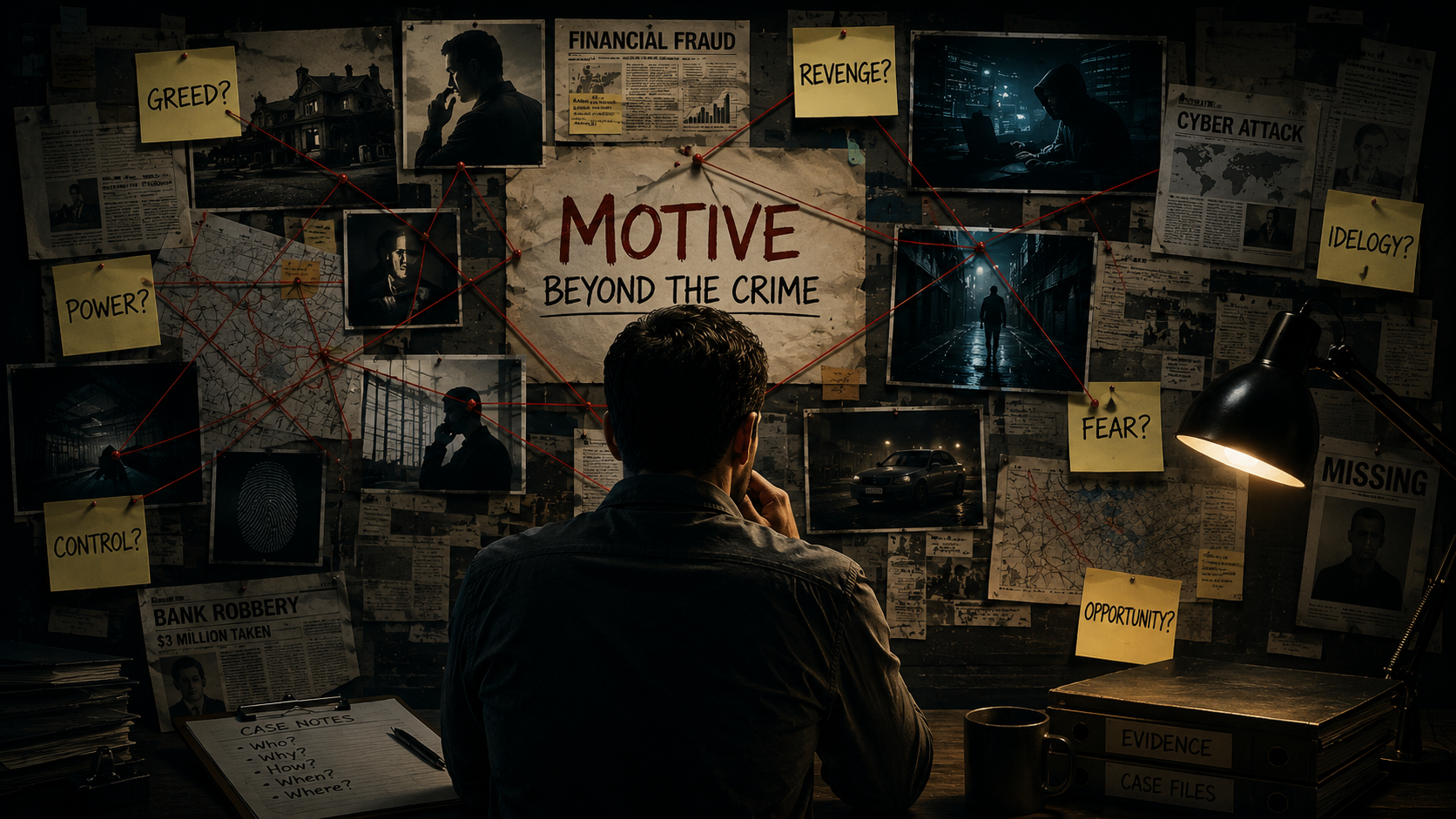
One of the most fascinating realities of criminal psychology is that identical crimes can emerge from vastly different motivations.
A theft may be motivated by:
- Poverty
- Greed
- Revenge
- Addiction
- Peer pressure
- Survival
A cyber intrusion may be motivated by:
- Financial gain
- Espionage
- Political ideology
- Personal curiosity
- Sabotage
- Prestige within criminal communities
A homicide may be motivated by:
- Jealousy
- Fear
- Revenge
- Financial incentives
- Personal conflict
The action itself reveals very little about the psychological forces behind it.
This is why investigators must look beyond the crime and examine the individual responsible.
Criminal Psychology and Behavioural Analysis
Criminal psychology attempts to bridge the gap between action and intention.
Rather than focusing solely on what occurred, psychologists examine the patterns that surround criminal behaviour.
Questions often include:
- What was the offender attempting to achieve?
- Was the crime planned or impulsive?
- What emotional state influenced the decision?
- What pressures existed before the offence?
- Was the offender motivated by fear, anger, greed, or ideology?
Former FBI profiler John E. Douglas summarised an important principle in criminal profiling:
“Behavior reflects personality.”
Actions are rarely random.
People reveal aspects of themselves through the choices they make, the risks they take, and the methods they employ.
Behaviour becomes a window into the hidden motivations that investigators cannot directly observe.
Criminal Motive in Cybercrime
The challenge becomes even greater in the digital world.
Traditional crimes often involve direct interaction between offender and victim. Cybercriminals, however, can operate anonymously across countries, jurisdictions, and continents.
An investigator may quickly determine how a breach occurred.
Perhaps credentials were stolen.
Perhaps a vulnerability was exploited.
Perhaps phishing emails were used.
The technical pathway may be obvious.
The motive may not.
Was the objective financial theft?
Was the attacker collecting intelligence?
Was the intrusion politically motivated?
Was the attack intended to damage reputation or disrupt operations?
The same technical evidence may support multiple theories.
This is why cyber threat intelligence relies heavily on behavioural analysis rather than technical indicators alone.
Technology can reveal capability.
It cannot always reveal intent.
The Problem of False Motives
Experienced investigators understand that criminals are capable of deception.
Sometimes offenders deliberately create misleading narratives.
A murder may be staged as a robbery.
A financial crime may be disguised as an ideological act.
A cyberattack may be designed to resemble the work of another threat actor.
The goal is simple: manipulate perception.
If investigators accept the apparent motive without questioning it, they may pursue the wrong leads.
This is why motive analysis requires caution.
The obvious explanation is not always the correct one.
Why Motive Matters
Some people argue that motive is irrelevant if investigators already know who committed the crime.
In reality, motive often determines the direction of an investigation.
Understanding motive helps investigators:
- Predict future behavior
- Identify additional suspects
- Discover hidden relationships
- Establish criminal intent
- Uncover broader criminal networks
For example, a financially motivated offender may leave entirely different patterns than an ideologically motivated offender.
The motive influences planning, target selection, risk tolerance, and post-crime behaviour.
Understanding motive allows investigators to understand not only the crime but the person behind it.
The Human Mind: The Ultimate Unknown
Modern investigations benefit from advanced technology.
Artificial intelligence can identify patterns.
Digital forensics can recover deleted data.
Surveillance systems can monitor movements.
Data analytics can reveal hidden connections.
Yet even the most sophisticated technology struggles to answer one simple question:
Why?
Human beings are influenced by emotions, beliefs, relationships, experiences, ambitions, fears, and personal histories.
Many of these influences remain invisible.
No forensic tool can directly measure resentment.
No algorithm can fully quantify revenge.
No database can completely explain hatred, greed, or obsession.
The human mind remains one of the most complex systems investigators encounter.
The Limits of Certainty
One of the most important lessons in criminal investigation is accepting uncertainty.
Not every motive can be discovered.
Not every question can be answered.
There are cases where investigators identify the offender, reconstruct the sequence of events, and secure a conviction while still lacking a complete understanding of motive.
The public often expects clear explanations.
Reality is more complicated.
Sometimes multiple motives coexist.
Sometimes the offender refuses to cooperate.
Sometimes the true motive dies with the individual responsible.
In such cases, investigators must rely on evidence rather than assumptions.
Looking Beyond the Evidence
Evidence tells us what happened.
Forensics explains how it happened.
Criminal motive attempts to explain why it happened.
Each layer reveals a different dimension of truth.
A crime scene tells a story.
A forensic report reveals a sequence of events.
A behavioural analysis uncovers patterns.
A motive provides context.
Former FBI profiler John E. Douglas expressed this investigative philosophy in a remarkably simple equation:
“Why + How = Who.”
The deeper investigators understand motive and behaviour, the closer they come to understanding the individual responsible.
Investigation Challenges: Understanding the Offender
One of the greatest challenges in any investigation is understanding the person behind the crime. Unlike fingerprints, DNA, or digital evidence, motive cannot be directly observed. Investigators must infer intent through behaviour, relationships, communications, financial activity, and surrounding circumstances.
This task is often complicated by deception. Suspects may lie, minimise their actions, or provide misleading explanations. Witnesses can misremember events, while friends and family may have only a limited understanding of the offender’s true motivations.
Human behaviour itself adds another layer of complexity. People are influenced by emotions, beliefs, personal experiences, fears, and social pressures. The same circumstances can produce very different reactions in different individuals, making motive difficult to determine with certainty.
Behavioural analyst Brent E. Turvey highlights this challenge:
“Behavioral evidence must be interpreted within the context in which it occurred.”
Without proper context, investigators risk misinterpreting actions and drawing incorrect conclusions about an offender’s true motives.
Investigation Challenges: Deception, Complexity, and Uncertainty
The second challenge involves the complexity of modern criminal investigations. Experienced offenders often understand how investigations work and may deliberately create misleading narratives. A homicide may be staged as an accident. Financial crimes may be disguised as legitimate transactions. Cyber attackers frequently mimic the techniques of other threat actors to confuse attribution efforts.
Multiple motives can further complicate investigations. Crimes are rarely driven by a single factor. Financial gain may coexist with revenge. Ideology may combine with personal grievance. Power, status, fear, and opportunity often interact in ways that make identifying a primary motive extremely difficult.
Investigators must also guard against cognitive bias. The most obvious explanation is not always the correct one. Premature conclusions can cause investigators to overlook alternative theories and critical evidence.
Perhaps the greatest challenge is accepting uncertainty. Not every motive can be fully explained. Some offenders refuse to cooperate, leave contradictory evidence, or die before their intentions can be understood. In these cases, investigators may successfully establish what happened and how it happened while still lacking a complete understanding of why it happened.
This reality highlights an important truth of criminal investigation: evidence can establish facts, but motive often exists in a grey area where certainty is limited and interpretation must be approached with caution.
Conclusion
The hidden criminal motive is often the most elusive aspect of any investigation. Whether the case involves fraud, murder, cybercrime, espionage, terrorism, or organised criminal activity, the challenge remains the same: understanding the mind behind the action.
Evidence can reveal what happened.
Forensics can explain how it happened.
But uncovering why it happened requires investigators to explore a hidden landscape of intentions, emotions, incentives, and human behaviour.
This is why criminal motive remains one of the most difficult and fascinating subjects in criminal investigation.
The crime may be visible to everyone.
The motive often exists in a place no investigator can directly observe.
It exists within the mind we do not see.
As Friedrich Nietzsche warned:
“Whoever fights monsters should see to it that in the process he does not become a monster.”
For investigators, psychologists, journalists, and analysts who spend their lives studying criminal behaviour, that reminder remains just as relevant today as ever.
Disclaimer
The quotations and concepts discussed in this article are presented for educational and analytical purposes. Criminal motive is a multidisciplinary subject that combines criminology, psychology, behavioural science, forensic investigation, and criminal intelligence. No single theory or model can fully explain human behaviour in every criminal case.
References & Further Reading
- Douglas, John E., & Olshaker, Mark. Mindhunter: Inside the FBI’s Elite Serial Crime Unit. Scribner, 1995.
https://www.simonandschuster.com/books/Mindhunter/John-E-Douglas/9781501191961 - Douglas, John E., Burgess, Ann W., Burgess, Allen G., & Ressler, Robert K. Crime Classification Manual: A Standard System for Investigating and Classifying Violent Crimes. Wiley.
https://www.wiley.com - Turvey, Brent E. Criminal Profiling: An Introduction to Behavioural Evidence Analysis. Academic Press.
https://www.elsevier.com/books/criminal-profiling/turvey/978-0-12-385243-4 - Canter, David. Criminal Shadows: Inside the Mind of the Serial Killer. HarperCollins.
https://www.harpercollins.com - Holmes, Ronald M., & Holmes, Stephen T. Profiling Violent Crimes: An Investigative Tool. Sage Publications.
https://us.sagepub.com - Bartol, Curt R., & Bartol, Anne M. Criminal Behaviour: A Psychological Approach. Pearson.
https://www.pearson.com - Ressler, Robert K., & Shachtman, Tom. Whoever Fights Monsters: My Twenty Years Tracking Serial Killers for the FBI. St. Martin’s Press.
https://us.macmillan.com - Ainsworth, Peter B. Offender Profiling and Crime Analysis. Willan Publishing.
https://www.routledge.com - Federal Bureau of Investigation (FBI) – Behavioural Analysis Unit (BAU)
https://www.fbi.gov - National Institute of Justice (NIJ) – Criminal Psychology and Behavioural Research
https://nij.ojp.gov - Agatha Christie. The Murder of Roger Ackroyd. William Collins.
https://www.agathachristie.com - Nietzsche, Friedrich. Beyond Good and Evil.
https://www.gutenberg.org/ebooks/4363




Leave a Reply