
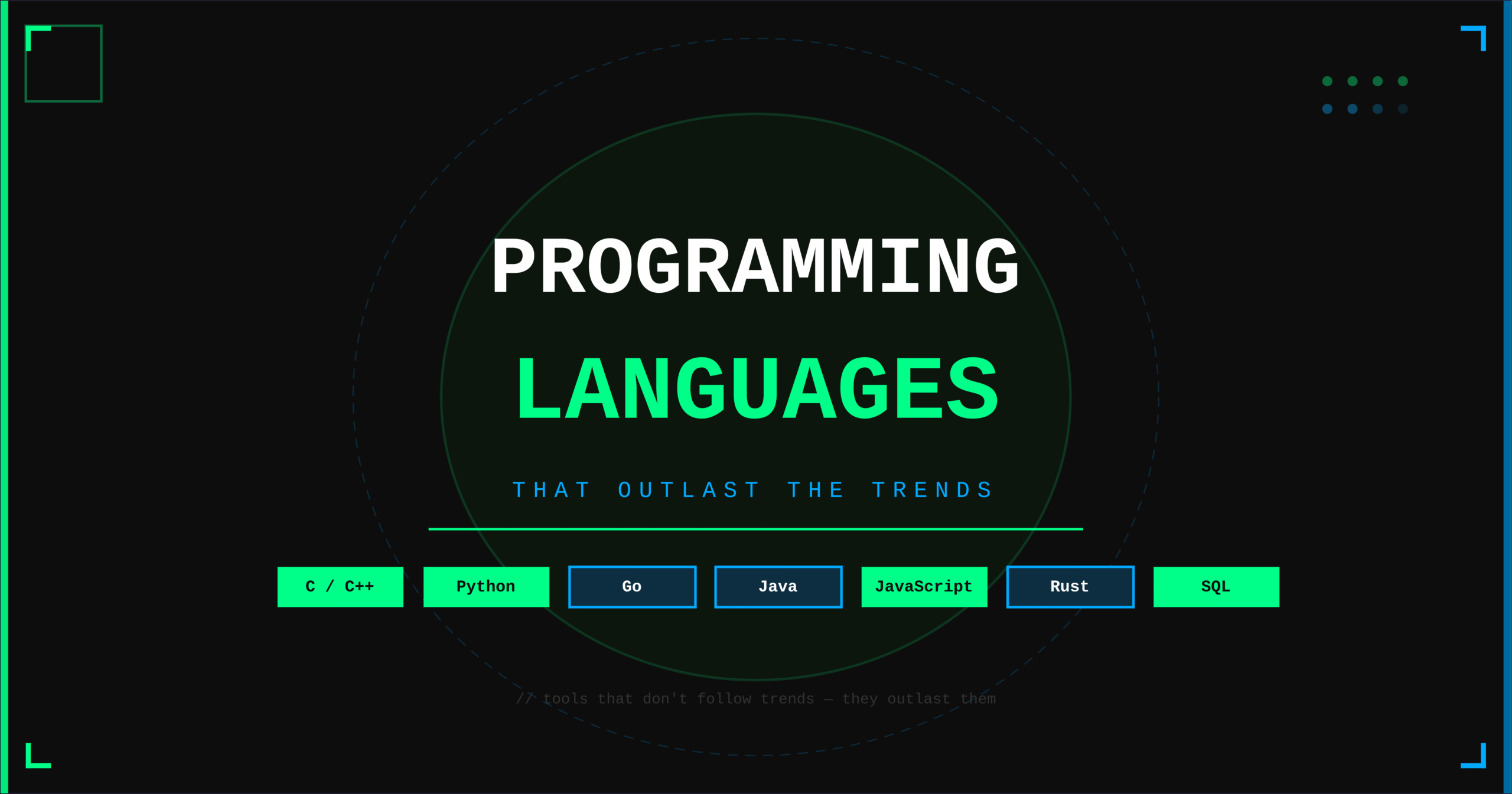
Choosing the right programming languages can feel like trying to predict the future. Every year, new tools appear, trends explode, and suddenly what you were learning yesterday feels outdated today.
That confusion traps a lot of people in a loop. They keep switching between technologies, chasing trends, and never go deep enough to build something meaningful.
Here’s the part most colleges and universities won’t tell you: it’s not about how many languages you know, it’s about how well you can use one to solve real problems.
If you step back and look at the industry over time, a pattern becomes clear. Some tools don’t just follow trends, they outlast them. They evolve, adapt, and remain relevant across different generations of technology.
This guide focuses on those.
What Makes a Language Last?
Not every programming languages is designed for longevity. Some rise fast because of hype, while others quietly become essential.
The ones that last usually have:
- Strong ecosystems with tools and libraries
- Real-world adoption in production systems
- Flexibility across domains like web, AI, and cloud
- Consistent demand in the job market
Another important factor is community. A strong developer base keeps improving the ecosystem, ensuring long-term survival.
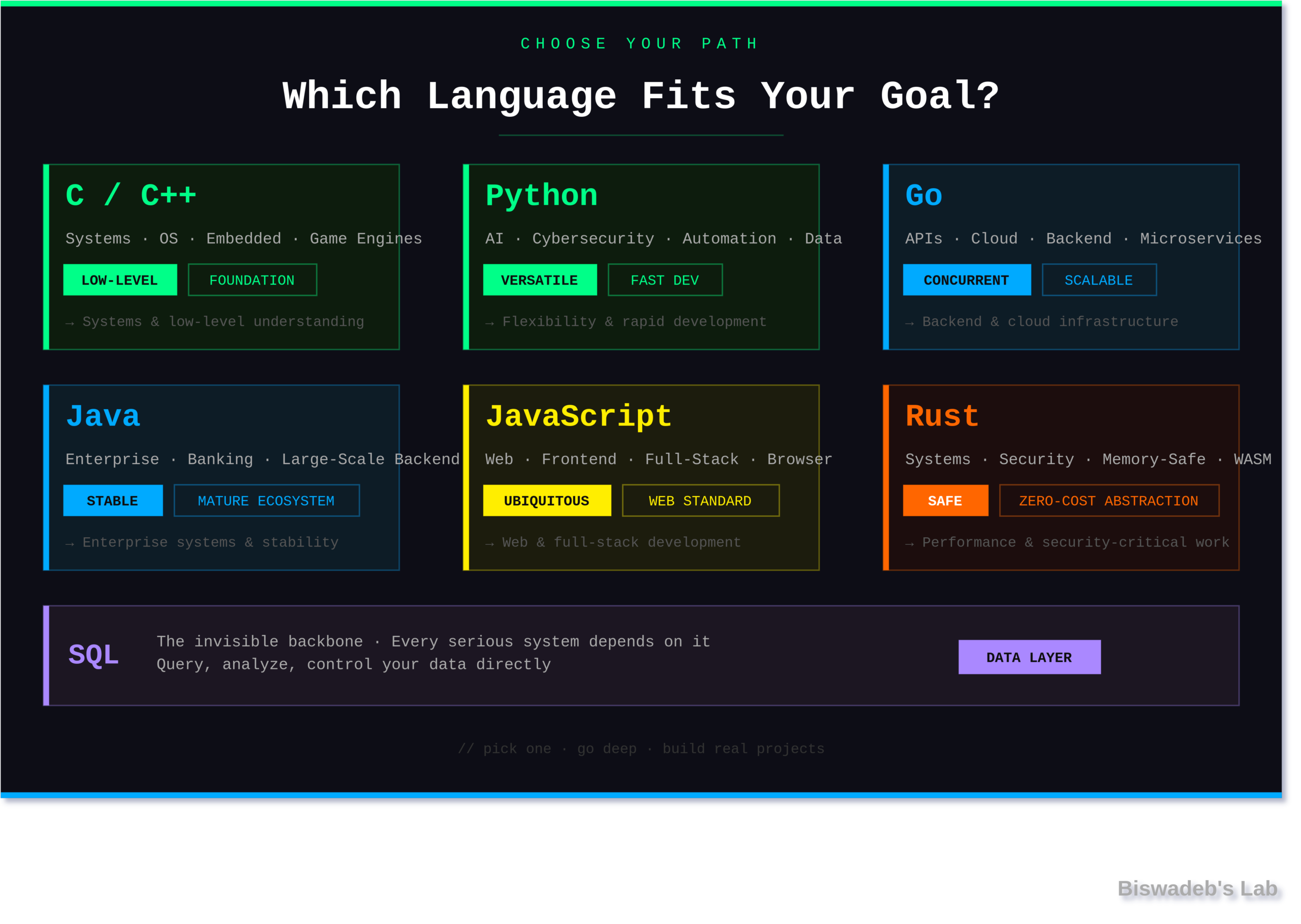
C and C++: The Foundation Layer
Most modern systems are built on concepts that originate from C and C++.
They power operating systems, embedded devices, game engines, and performance-heavy applications. These languages give you direct control over memory and hardware.
Learning them forces you to understand what’s happening under the hood. That knowledge carries over into everything else you learn.
They are not the easiest starting point, but they are foundational. And foundations don’t disappear.
Python: Simplicity with Reach
Python is one of the most flexible tools you can learn.
It’s used in automation, artificial intelligence, web development, cybersecurity, and data science. Very few options can cover so many areas effectively.
Its biggest strength is balance. It’s easy to start with, but powerful enough for serious work.
Another reason it continues to grow is how quickly it adapts. New domains often see strong Python support early on.
Go: Built for Modern Systems
Go was designed for today’s backend challenges.
It focuses on performance, simplicity, and handling multiple tasks efficiently. That makes it ideal for APIs, cloud services, and distributed systems.
Many infrastructure tools rely on Go, which keeps it deeply relevant in backend engineering.
It doesn’t try to do everything. It focuses on doing a few things extremely well.
Java: Stability at Scale
Java continues to power large-scale systems across industries.
Enterprise platforms, banking systems, and backend services rely on it because of its stability and predictability.
Its ecosystem has matured over decades, making development structured and reliable.
It may not always be trendy, but it remains one of the safest long-term choices.
JavaScript: The Web Standard
JavaScript is unavoidable if you’re working with the web.
Every browser runs it. Every interactive site depends on it.
Over time, it has expanded beyond the frontend into backend and full-stack development.
Its continuous evolution keeps it relevant, even as new tools try to compete.
Rust: Performance with Safety
Rust is gaining attention for solving a long-standing problem.
It provides performance similar to low-level languages while ensuring memory safety. That combination makes it valuable for systems programming and security work.
It’s harder to learn, but it offers a level of control and reliability that’s hard to match.
Its growth is steady and backed by real use cases.
SQL: The Data Layer
While other tools build applications, SQL works behind the scenes managing data.
Every serious system depends on databases. SQL is how you interact with them.
It allows you to query, analyze, and control data directly.
It’s not flashy, but it’s essential.
How to Choose the Right Path
You don’t need to learn everything.
Instead, choose based on your direction:
- Systems and low-level understanding → C/C++
- Flexibility and fast development → Python
- Backend and cloud → Go
- Enterprise systems → Java
- Web development → JavaScript
- Performance and security → Rust
- Data handling → SQL
Pick one, go deep, and build real projects.
The Bigger Picture
Programming Languages are tools.
What matters more is how you think, how you solve problems, and how well you understand systems.
Once your fundamentals are strong, switching tools becomes easy.
The biggest mistake is chasing trends instead of building depth.
Final Thoughts
You don’t need perfect predictions. You need clarity.
The options discussed here have proven themselves over time. They are not just popular, they are reliable.
If you invest time in learning them properly, you build skills that stay valuable.
Stop guessing. Pick one. Build something real.
That’s what actually lasts.
References
These references are based on global developer surveys, industry reports, and long-term programming trends.
- Stack Overflow — Developer Survey insights on language usage and demand
https://survey.stackoverflow.co/ - GitHub — Octoverse reports and repository trends
https://octoverse.github.com/ - TIOBE Index — Long-term programming language rankings
https://www.tiobe.com/tiobe-index/ - RedMonk — Language popularity analysis
https://redmonk.com/sogrady/category/programming-languages/ - JetBrains — State of Developer Ecosystem reports
https://www.jetbrains.com/lp/devecosystem/ - IEEE — Programming language rankings and insights
https://spectrum.ieee.org/top-programming-languages/








Leave a Reply