
Introduction
The comparison of process vs thread Windows vs Linux is essential for understanding how operating systems manage execution, performance, and multitasking. Whether you are developing high-performance applications, working on system-level programming, or analyzing operating system behavior, understanding process vs thread Windows vs Linux helps you make better design decisions. Furthermore, this topic is critical when dealing with scalability, concurrency, and system optimization. In this article, we will explore process vs thread Windows vs Linux in depth, focusing on architecture, performance, scheduling, and real-world use cases.
Understanding Processes and Threads
To fully understand process vs thread Windows vs Linux, you must first understand the core concepts of processes and threads.
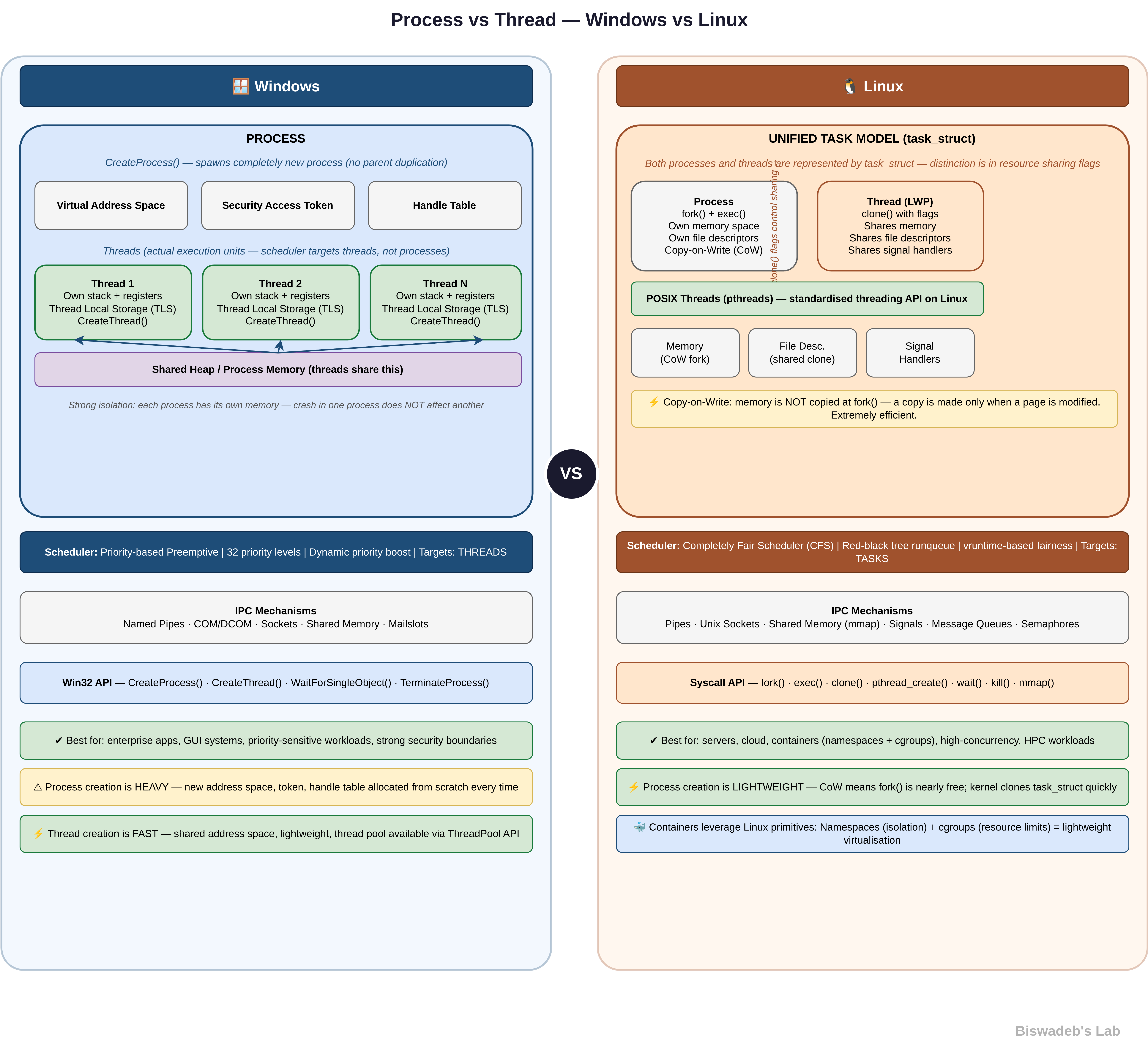
A process is an independent execution unit with its own memory space, system resources, and execution state. It provides isolation, which means one process cannot directly interfere with another.
On the other hand, a thread is a lightweight execution unit within a process. Multiple threads share the same memory space and resources but can execute independently. As a result, threads are faster and more efficient but less isolated.
Key Differences
| Feature | Process | Thread |
|---|---|---|
| Memory | Separate address space | Shared within process |
| Overhead | High | Low |
| Communication | IPC mechanisms | Direct memory access |
| Isolation | Strong | Weak |
| Creation Time | Slower | Faster |
Therefore, processes are ideal for isolation, while threads are better suited for performance and concurrency.
Process Management in Windows
In the process vs thread Windows vs Linux comparison, Windows follows a structured and object-oriented approach.
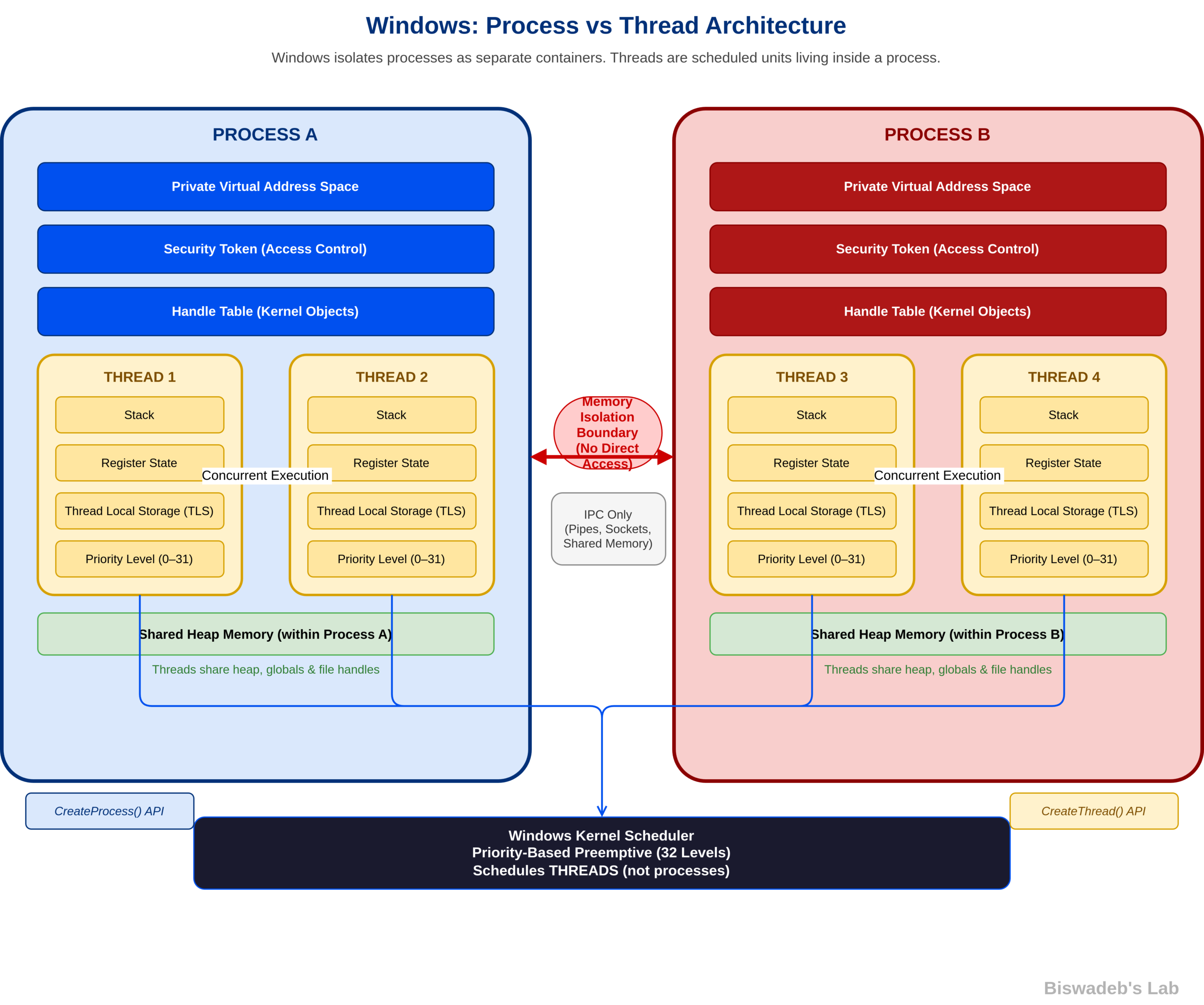
Each process in Windows contains:
- A private virtual address space
- A security token
- A handle table
- A list of threads
Creation Model
Windows uses the CreateProcess() API. Unlike Linux, this does not duplicate the parent process. Instead, it creates a completely new process from scratch. Consequently, process creation is more controlled but also more resource-intensive.
Characteristics
- Strong isolation using virtual memory
- Security enforced through access tokens
- Clear distinction between processes and threads
Insight
As a result, Windows processes are heavier. However, they provide better security and stability, especially in enterprise environments.
Thread Management in Windows
Threads are the actual execution units in Windows, and they play a central role in performance.
Features
- Each thread has its own stack and register state
- Supports Thread Local Storage (TLS)
- Managed by the Windows scheduler
Scheduling
Windows uses a priority-based preemptive scheduler. Additionally, it supports 32 priority levels and dynamic adjustments. Therefore, it ensures responsiveness and fairness.
Important Detail
Windows schedules threads rather than processes. Consequently, thread behavior directly impacts system performance in the process vs thread Windows vs Linux comparison.
Process Management in Linux
Linux takes a different and more flexible approach in the process vs thread Windows vs Linux discussion.
Unified Model
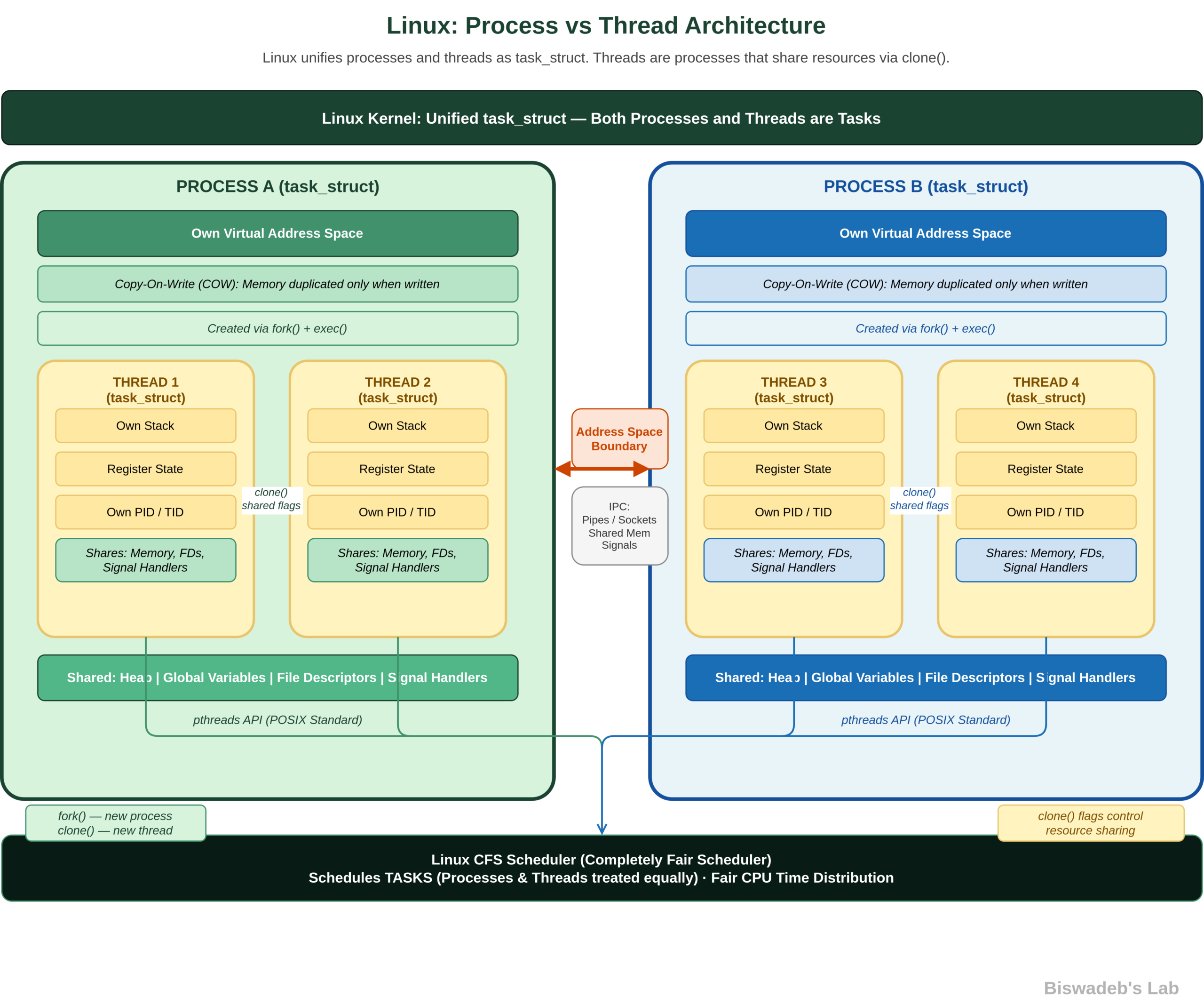
Linux uses a unified abstraction where both processes and threads are represented using task_struct. As a result, the distinction between them is minimal.
Creation Model
Linux uses:
fork()to duplicate a processexec()to replace process memoryclone()to create thread-like tasks
Copy-On-Write Optimization
Instead of copying memory immediately, Linux uses Copy-On-Write (COW). Initially, memory is shared. However, when modifications occur, a copy is created. This approach significantly improves efficiency.
Insight
Therefore, Linux processes are lightweight and efficient, which makes them ideal for high-performance systems.
Thread Management in Linux
Linux implements threads differently compared to Windows.
Implementation
Threads are created using clone(). Depending on the flags used, threads can share:
- Memory
- File descriptors
- Signal handlers
POSIX Threads
Most applications use pthreads. This provides a standardized interface for multithreading.
Scheduling
Linux uses the Completely Fair Scheduler (CFS). As a result, CPU time is distributed fairly among tasks. Moreover, it ensures balanced performance under heavy workloads.
Key Insight
In Linux, threads are essentially processes that share resources. Therefore, the process vs thread Windows vs Linux distinction becomes more flexible.
Core Differences Between Windows and Linux
Design Philosophy
| Aspect | Windows | Linux |
|---|---|---|
| Approach | Structured | Minimal and flexible |
| Model | Separate abstractions | Unified task model |
Windows emphasizes structure and control. In contrast, Linux focuses on flexibility and efficiency.
Process vs Thread Relationship
- Windows:
- Processes act as containers
- Threads execute within processes
- Linux:
- Both are tasks
- Behavior depends on resource sharing
Creation Mechanism
| OS | Process Creation | Thread Creation |
|---|---|---|
| Windows | CreateProcess | CreateThread |
| Linux | fork | clone |
Notably, Linux offers greater flexibility through clone().
Memory Management
- Windows uses strict separation, which increases overhead.
- Linux uses Copy-On-Write, which improves efficiency.
Scheduling Strategy
| Feature | Windows | Linux |
|---|---|---|
| Type | Priority-based | Fair scheduling |
| Goal | Responsiveness | Fair CPU distribution |
Performance Comparison
In the process vs thread Windows vs Linux discussion, performance varies depending on the workload.
Thread Performance
Linux performs well in high-concurrency environments. This is because threads are lightweight and share resources efficiently. On the other hand, Windows performs well in priority-driven systems where control is important.
Process Performance
Windows processes are heavier but provide strong isolation. Meanwhile, Linux processes are lightweight and faster to create. Therefore, Linux is often preferred for scalable systems.
Real-World Scenario
Consider a web server handling thousands of connections.
- In Linux, lightweight threads and efficient scheduling allow better scalability.
- In Windows, thread pools and priority scheduling provide stability and predictability.
Thus, both systems offer advantages depending on the use case.
Security Considerations
Windows
Windows enforces strong process isolation. Additionally, it uses access tokens for security. As a result, processes are well protected.
Linux
Linux provides flexibility. However, it requires proper configuration. It relies on permissions, capabilities, and namespaces.
Insight
Overall, Windows focuses on built-in security. In contrast, Linux provides more control to the user.
Use Cases
When to Use Processes
- When isolation is required
- When security is critical
- When fault tolerance is needed
When to Use Threads
- When performance matters
- When tasks share data
- When parallel execution is required
OS Preference
Windows is suitable for enterprise applications and GUI systems. In contrast, Linux is ideal for servers, cloud environments, and high-performance workloads.
Modern Trends: Containers
Containers extend the process vs thread Windows vs Linux discussion further.
Linux containers use:
- Namespaces
- cgroups
These features isolate processes while controlling resources. As a result, containers provide lightweight virtualization.
Key Takeaways
- Processes are isolated and heavyweight
- Threads are lightweight and efficient
- Windows separates processes and threads clearly
- Linux unifies both concepts
- Linux scales better in high-concurrency systems
- Windows provides structured control and stability
Conclusion
The process vs thread Windows vs Linux comparison highlights two fundamentally different approaches. Windows focuses on structure, isolation, and security. In contrast, Linux emphasizes flexibility, efficiency, and scalability.
Ultimately, understanding process vs thread Windows vs Linux allows you to design better systems, optimize performance, and make informed decisions in real-world scenarios.
References
- Silberschatz, Abraham – Operating System Concepts
https://www.os-book.com/ - Robert Love – Linux Kernel Development
https://www.pearson.com/en-us/subject-catalog/p/linux-kernel-development/P200000003178 - Andrew S. Tanenbaum – Modern Operating Systems
https://www.pearson.com/en-us/subject-catalog/p/modern-operating-systems/P200000003185 - Microsoft Documentation – Windows Internals
https://learn.microsoft.com/en-us/windows/win32/procthread/processes-and-threads - Linux Kernel Documentation – fork(), clone(), task_struct
https://www.kernel.org/doc/html/latest/ - POSIX Threads Standard (IEEE)
https://pubs.opengroup.org/onlinepubs/9699919799/functions/pthread_create.html









Leave a Reply