
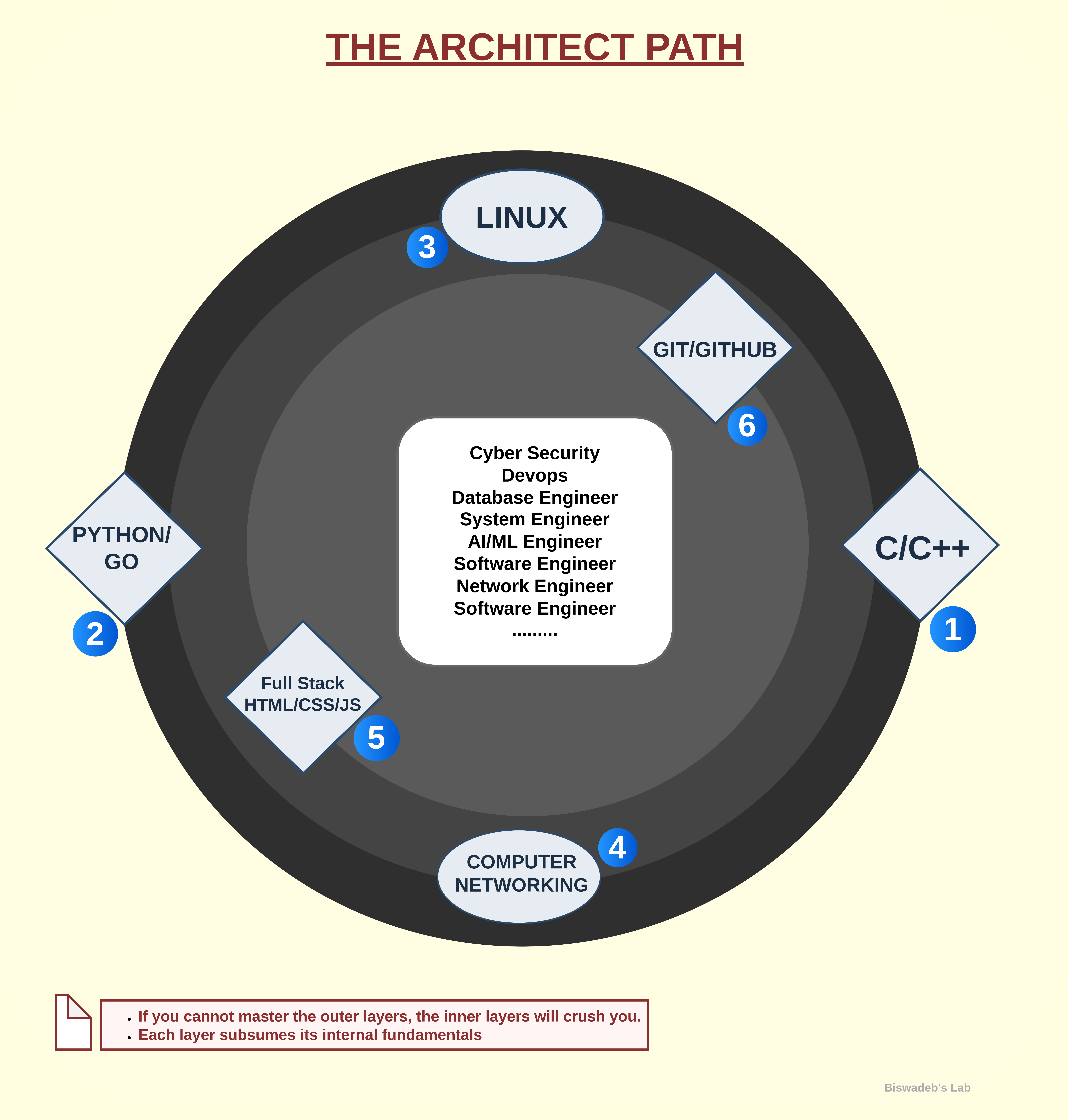
The Architect Path Foundations are not optional. They define whether you become someone who truly understands systems or someone who merely operates them. From the outside, it may look like progress to jump directly into high-level tools, frameworks, or trendy domains. However, without solid Architect Path Foundations, that progress is often shallow, fragile, and short-lived.
At first, skipping layers feels efficient. After all, modern ecosystems are designed to hide complexity. You can deploy services, train models, or automate infrastructure with minimal effort. Yet beneath that convenience lies a critical truth: abstraction does not remove complexity, it only relocates it. Sooner or later, that hidden complexity surfaces, and when it does, your foundation determines whether you solve the problem or struggle with it.
The Illusion of Progress
In the beginning, everything seems to work. You build applications quickly, integrate APIs, and deliver results. Consequently, it creates a sense of momentum. However, this momentum is often misleading.
Without Architect Path Foundations, you are stacking systems on assumptions rather than understanding. When something breaks, and it inevitably will, debugging turns into guesswork instead of reasoning. Therefore, what seemed like speed becomes a bottleneck.
In contrast, engineers who respect foundational layers approach problems differently. They trace issues downward. They analyze behavior instead of reacting to symptoms. As a result, they move slower initially but far faster in the long run.
Layer 1: C/C++ — Understanding the Machine
At the outer edge of the Architect Path Foundations lies low-level programming, primarily C or C++. This is where abstraction fades and reality begins.
Here, you confront the raw mechanics of computing:
- Memory allocation and deallocation
- Pointer arithmetic and addressing
- Stack versus heap behavior
- Binary execution and layout
- Undefined behavior and system crashes
Because of this exposure, your mental model changes. You stop thinking in terms of “code that works” and start thinking in terms of “code that behaves correctly under constraints.”
Moreover, this layer is essential for understanding vulnerabilities. Buffer overflows, memory corruption, and exploitation techniques are not magic tricks. Instead, they are predictable outcomes of mismanaged memory.
If this layer is skipped, everything built above becomes uncertain. You may still produce results, but you lack the ability to reason about failure.
Layer 2: Python / Go — Controlled Abstraction
Once the machine is understood, the next step in the Architect Path Foundations introduces higher-level languages such as Python or Go. These languages increase productivity while still allowing insight into system behavior.
At this stage, abstraction becomes a tool rather than a dependency.
For instance, Python enables rapid prototyping and automation. Meanwhile, Go introduces efficient concurrency and system-level performance. However, because you already understand what lies beneath, you can evaluate trade-offs instead of blindly trusting the runtime.
As a result:
- You recognize performance bottlenecks early
- You understand how concurrency actually behaves
- You select tools based on constraints, not trends
On the other hand, skipping foundational knowledge turns these languages into limitations. You can write code, but you cannot explain its deeper behavior.
Layer 3: Linux — The Execution Environment
Moving further into the Architect Path Foundations, Linux becomes unavoidable. Nearly every modern system depends on it or something closely related.
At this layer, theory becomes operational:
- Process lifecycle and scheduling
- File systems and permission models
- Signals and inter-process communication
- System calls and kernel interaction
- Resource management under load
Because Linux is where code executes, understanding it gives you control over real-world behavior. Additionally, it reveals how systems fail in production environments.
Without this knowledge, you are essentially deploying into an environment you do not fully understand. Consequently, troubleshooting becomes reactive instead of systematic.
Layer 4: Computer Networking — System Connectivity
After mastering execution environments, the Architect Path Foundations extend into networking. Systems rarely operate in isolation, so understanding communication is critical.
This layer includes:
- TCP/IP fundamentals
- Packet flow and routing
- DNS resolution and failures
- Latency and congestion
- Network-level attack surfaces
Through networking, invisible processes become visible. You begin to see how data travels, where it can be intercepted, and why systems behave differently under varying conditions.
Furthermore, security awareness deepens at this stage. Many real-world attacks exploit network behavior. Therefore, without networking knowledge, your understanding of security remains incomplete.
Layer 5: Full Stack — The Human Interface
At this point in the Architect Path Foundations, you reach the interface layer, where systems interact with users. Full stack development, including HTML, CSS, and JavaScript, sits here.
Although many developers start at this layer, approaching it after mastering lower layers changes everything.
Instead of focusing only on visuals or functionality, you now understand:
- How browsers execute scripts and enforce isolation
- How APIs communicate with backend systems
- How client-side logic can be manipulated
- How performance issues propagate across layers
Consequently, this layer becomes more than presentation. It becomes an extension of system design.
Layer 6: Git / GitHub — Managing Evolution
Finally, the Architect Path Foundations include version control. Git and GitHub are not just tools for storing code. They are systems for managing change.
At this level, you learn:
- Structured collaboration
- Codebase evolution over time
- Traceability and accountability
- Branching strategies and conflict resolution
Because of earlier layers, version control becomes strategic rather than mechanical. You are not just committing code. You are shaping how systems evolve.
The Core: Convergence of Disciplines
At the center of the Architect Path Foundations lies the outcome: roles that demand deep, interconnected knowledge.
These include:
- Cyber Security
- DevOps
- Database Engineering
- System Engineering
- AI/ML Engineering
- Software Engineering
- Network Engineering
Each domain relies on multiple layers simultaneously. For example, security depends on networking, Linux, and low-level programming. Similarly, DevOps requires strong system and infrastructure understanding.
Therefore, specialization does not replace foundations. Instead, it builds upon them.
Why Skipping Foundations Fails
Skipping Architect Path Foundations does not always cause immediate failure. In fact, early success is common. However, over time, deeper challenges emerge.
You encounter:
- Performance issues without clear causes
- Bugs that resist reproduction
- Systems that behave unpredictably under stress
At this point, the lack of foundational knowledge becomes visible. You are forced to revisit concepts you initially avoided.
Unfortunately, learning under pressure is harder. You must maintain systems while correcting misunderstandings. As a result, progress slows significantly.
The Compounding Effect
One of the most powerful aspects of the Architect Path Foundations is their compounding nature.
For example:
- Low-level knowledge improves debugging across all languages
- Linux expertise enhances deployment and system reliability
- Networking insight strengthens both security and scalability
- Full stack awareness connects user behavior with backend logic
Because these layers reinforce each other, your capability grows exponentially. Over time, you stop reacting to systems and start anticipating them.
The Architect Mindset
Ultimately, the Architect Path Foundations shape how you think.
Instead of asking how to use a tool, you ask why the tool exists.
Instead of trusting abstractions, you analyze their limits.
Instead of memorizing solutions, you derive them from principles.
This shift is subtle but transformative. It separates surface-level execution from true system design.
Final Reflection
There is no shortcut around the Architect Path Foundations. While the order can vary slightly, the layers themselves cannot be ignored.
Every system, no matter how advanced, rests on these fundamentals. Skipping them leads to fragile knowledge and reactive problem-solving. Embracing them leads to clarity, control, and long-term growth.
In the end, the difference is simple.
You either build on solid ground, or you spend your career fixing cracks.
References
- Computer Systems: A Programmer’s Perspective
https://csapp.cs.cmu.edu/ - Operating Systems: Three Easy Pieces
https://pages.cs.wisc.edu/~remzi/OSTEP/ - The Linux Programming Interface
https://man7.org/tlpi/ - Computer Networking: A Top-Down Approach
https://gaia.cs.umass.edu/kurose_ross/index.php - Clean Code
https://www.oreilly.com/library/view/clean-code/9780136083238/ - Designing Data-Intensive Applications
https://dataintensive.net/ - Structure and Interpretation of Computer Programs
https://mitpress.mit.edu/9780262510875/structure-and-interpretation-of-computer-programs/ - Linux kernel
https://www.kernel.org/ - Git
https://git-scm.com/ - Docker
https://www.docker.com/ - OWASP
https://owasp.org/www-project-top-ten/ - MIT OpenCourseWare
https://ocw.mit.edu/ - The Pragmatic Programmer
https://pragprog.com/titles/tpp20/the-pragmatic-programmer-20th-anniversary-edition/ - Code: The Hidden Language of Computer Hardware and Software
https://www.charlespetzold.com/code/






Leave a Reply